How to Stop the Spiral: 4 Research-Backed Ways Athletes Bounce Back from Mistakes
How Athletes Bounce Back from Mistakes: Countering Negativity Bias in Sports
Last time, we covered why your brain clings to that one missed shot instead of the three good ones — and why the spiral that follows (negative self-talk, rising anxiety, choking) is a real, documented pattern, not a personal failing. Good news: it’s also a pattern researchers have spent decades figuring out how to interrupt. Here’s what the evidence actually says works.
Talk to Yourself Differently — On Purpose
If negative self-talk fires automatically after a missed shot, the fix isn’t trying to have no thoughts. It’s changing what those thoughts say.
Cognitive restructuring works. Older but foundational research (Rogerson & Hrycaiko, 2002) found that the negative performance effects of self-talk could be reduced through cognitive restructuring or simple thought-stopping techniques — catching the negative thought and consciously redirecting it. This isn’t just a feel-good idea; it shows up in measurable performance change.
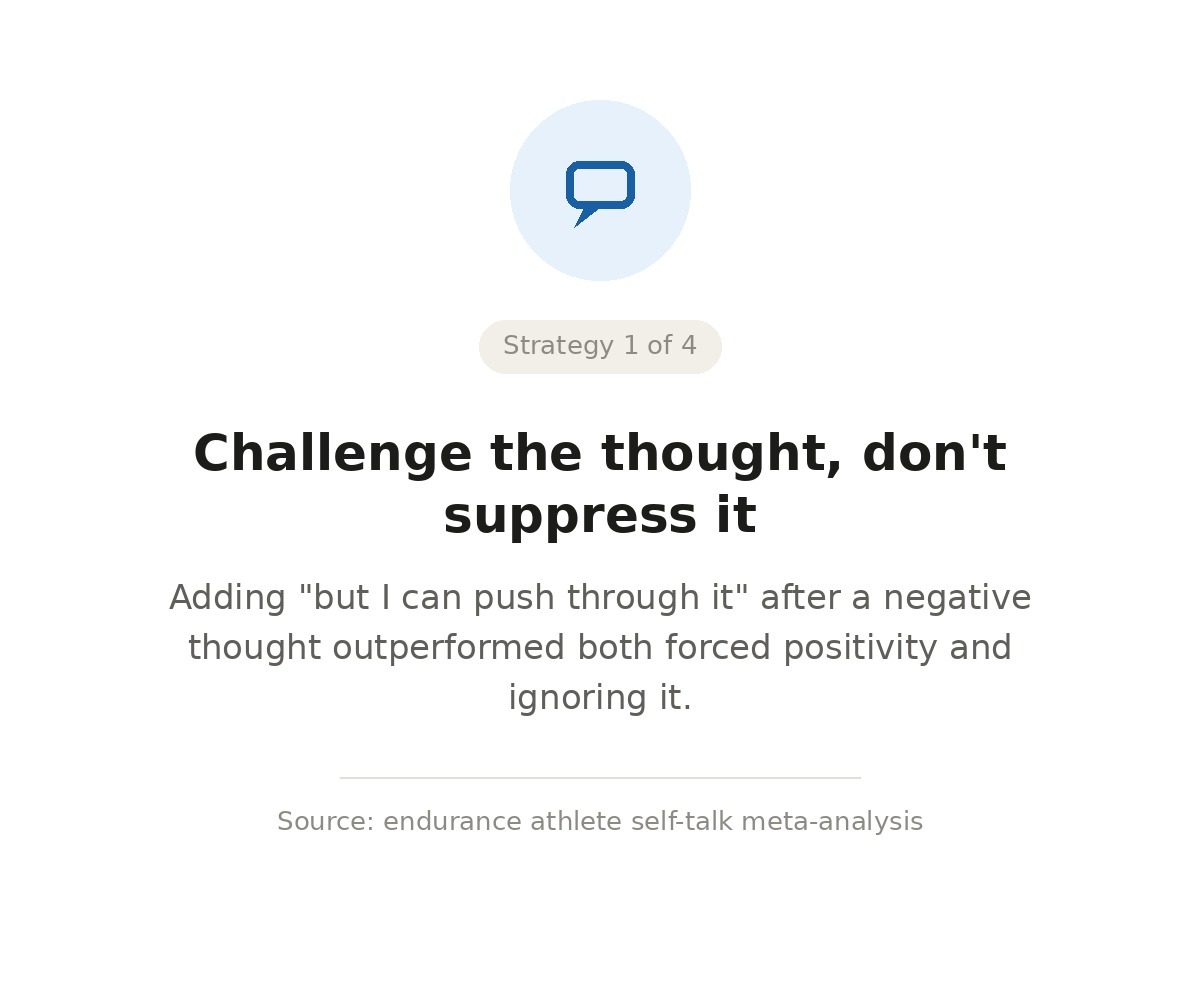
You don’t have to eliminate the negative thought — you can challenge it instead. A recent meta-analysis on endurance athletes found something surprisingly practical: instead of trying to replace “my legs are tired” with forced positivity, athletes who added a challenge statement — acknowledging the difficulty, then asserting they could push through it — performed significantly better in the final stretch of a task than those who left the negative thought unchallenged. The lesson for Pickleball: you don’t need to lie to yourself after a bad point. “That was rough, but I can reset for the next one” beats both denial and spiraling.
Self-talk training is trainable, not just theoretical. A controlled study with junior competitive athletes (Walter, Nikoleizig & Alfermann, 2019) randomly assigned athletes to self-talk training programs of different lengths versus a no-training control group. The athletes who received training showed measurably lower competitive anxiety and higher self-confidence and self-efficacy compared to the control group — and longer training produced bigger effects than shorter training. This wasn’t a one-off pep talk; it was a structured, repeatable skill.
Be Kind to Yourself When You Mess Up
This one goes directly against what a lot of athletes — amateur and elite — believe. Many assume self-criticism is what keeps them sharp, and that going easy on themselves after a mistake invites complacency. The research says the opposite.
A real intervention, tested in a randomized controlled trial. Mosewich and colleagues (2013) developed a short, seven-day self-compassion intervention for self-critical female athletes, built around psycho education and structured writing exercises. Compared to a control group, athletes in the intervention group showed increased self-compassion and decreased self-criticism and rumination — and those improvements were still present a full month later. This wasn’t a temporary mood boost; it changed how they related to mistakes going forward.
It scales to teams, not just individuals. A more recent program called RESET (Kuchar, Neff & Mosewich) delivered a similar self-compassion approach to entire collegiate teams rather than individual athletes. It supported both athlete well being and perceived sport performance, and was most beneficial for athletes who had the most room to grow — meaning the athletes who were hardest on themselves to begin with benefited the most.
Self-compassion speeds recovery from mistakes specifically. Separate research has linked higher self-compassion in athletes to faster recovery from mistakes during competition itself — not just better mood afterward, but a quicker return to baseline performance in the moment.
The practical version for your next Pickleball match: the instinct to mentally rip yourself apart after a missed shot isn’t discipline. It’s actually working against you.
Train Your Eyes, Not Just Your Mind
This is one of the more surprising findings in the choking-under-pressure literature, and it’s wonderfully simple.
The “quiet eye” matters more than people realize. Sport scientist Joan Vickers found that elite performers — across basketball free throws, golf putting, and other precision tasks — fixate their gaze on the target for noticeably longer before acting than less skilled performers do. This extended, steady gaze is called the “quiet eye,” and shorter quiet-eye duration is associated with more misses, especially under pressure.
It can be trained, and the training holds up in real competition. A controlled study with elite golfers (Vine, Moore & Wilson, 2011) trained one group specifically on quiet-eye technique and compared them to a control group. The trained group didn’t just putt better in the lab — their improved quiet-eye duration and putting performance carried over into real competitive rounds.
A systematic review found it’s one of the few choking interventions with real evidence behind it. A 2017 review of 47 studies on choking interventions found that the most consistently effective approaches were pre-performance routines, quiet eye training, brief left-hand contractions (used to shift activation away from overthinking, verbal-dominant brain regions), and acclimatization training deliberately practicing under simulated pressure so competition feels less novel.
For Pickleball, the practical version is simple: before your next serve or return, deliberately hold your gaze on the ball a beat longer than feels natural. It sounds almost too small to matter but it’s one of the few techniques with controlled trial evidence behind it.
Don’t Calm Down — Get Excited
This finding cuts against most people’s instinct, and it comes from a clever insight about how anxiety actually works in the body.
Anxiety and excitement feel almost identical physiologically. Both involve a racing heart and heightened arousal. Harvard researcher Alison Wood Brooks (2014) found that because anxiety and excitement share this physiological signature, re-framing nervous energy as excitement is an easier, more effective mental shift than trying to force yourself to calm down which requires fighting your body’s actual state rather than reinterpreting it.
Simple self-talk produced a measurable performance edge. Across several experiments karaoke singing, public speaking, math tests participants who said “I am excited” out loud, or were simply told to get excited, outperformed those instructed to calm down or those who did nothing. Reappraising anxiety as excitement helped people adopt what Brooks called an opportunity mindset instead of a threat mindset.
It replicated in a real academic performance setting. A follow-up study (Jamieson et al., 2016) brought this into actual classroom exam conditions and found that students who were taught to reappraise stress arousal performed better and reported less evaluation anxiety than students told to simply ignore their stress.
Translated to Pickleball: that first match nervous energy, or the jolt after a tight point, isn’t necessarily something to suppress. Telling yourself you’re excited rather than anxious may be doing more for your next shot than trying to talk yourself down.
The Big Picture: This Stuff Actually Moves the Needle
It’s worth zooming out for a second. A systematic review that synthesized 30 separate meta-analyses across sport psychology covering constructs like confidence, cohesion, and mindfulness found a moderate beneficial effect on performance overall, while factors like cognitive anxiety and negative mental states had a smaller, but real, detrimental effect. In plain terms: the mental side of sport isn’t a soft add-on. It has a measurable, research-backed impact on outcomes, in both directions.
None of these techniques make the negativity bias disappear that’s not how deeply wired cognitive patterns work. But each one gives you a specific, evidence-based way to interrupt the spiral before it runs the whole match: challenge the negative thought instead of fighting it, meet your mistakes with some compassion instead of punishment, hold your gaze a beat longer before you swing, and tell yourself you’re excited instead of anxious. Small moves, real research behind them.
References
Rogerson, L. J., & Hrycaiko, D. W. (2002). Enhancing competitive performance of ice hockey goaltenders using centering and self-talk. Journal of Applied Sport Psychology.
“Effect of self-talk on runners’ performance: systematic review and mini meta-analysis.” ResearchGate. https://www.researchgate.net/publication/387867531
Walter, N., Nikoleizig, L., & Alfermann, D. (2019). Effects of self-talk training on competitive anxiety, self-efficacy, volitional skills, and performance: An intervention study with junior sub-elite athletes. Sports, 7(6), 148. https://doi.org/10.3390/sports7060148
Mosewich, A. D., Crocker, P. R. E., Kowalski, K. C., & DeLongis, A. (2013). Applying self-compassion in sport: An intervention with women athletes. Journal of Sport and Exercise Psychology. https://self-compassion.org/wp-content/uploads/2015/12/Mosewich_intervention.pdf
Kuchar, A. L., Neff, K. D., & Mosewich, A. D. RESET: A brief self-compassion intervention with NCAA student-athletes. Psychology of Sport and Exercise. https://www.sciencedirect.com/science/article/abs/pii/S146902922300050X
“The effects of self-compassion on daily emotion regulation and performance rebound among college athletes.” Psychology of Sport and Exercise. https://www.sciencedirect.com/science/article/abs/pii/S1469029221001990
Vine, S. J., Moore, L. J., & Wilson, M. R. (2011). Quiet eye training facilitates competitive putting performance in elite golfers. Frontiers in Psychology, 2, 8. https://doi.org/10.3389/fpsyg.2011.00008
“Choking interventions in sports: A systematic review.” (2017). International Review of Sport and Exercise Psychology. https://www.tandfonline.com/doi/full/10.1080/1750984X.2017.1408134
Brooks, A. W. (2014). Get excited: Reappraising pre-performance anxiety as excitement. Journal of Experimental Psychology: General, 143(3), 1144–1158. https://pubmed.ncbi.nlm.nih.gov/24364682/
Jamieson, J. P., Peters, B. J., Greenwood, E. J., & Altose, A. J. (2016). Reappraising stress arousal improves performance and reduces evaluation anxiety in classroom exam situations. Social Psychological and Personality Science. https://files.eric.ed.gov/fulltext/ED566260.pdf
“A systematic review of meta-analyses in sport psychology.” Summary of 30 meta-analyses, 1983–2021. https://www.researchgate.net/publication/387867531