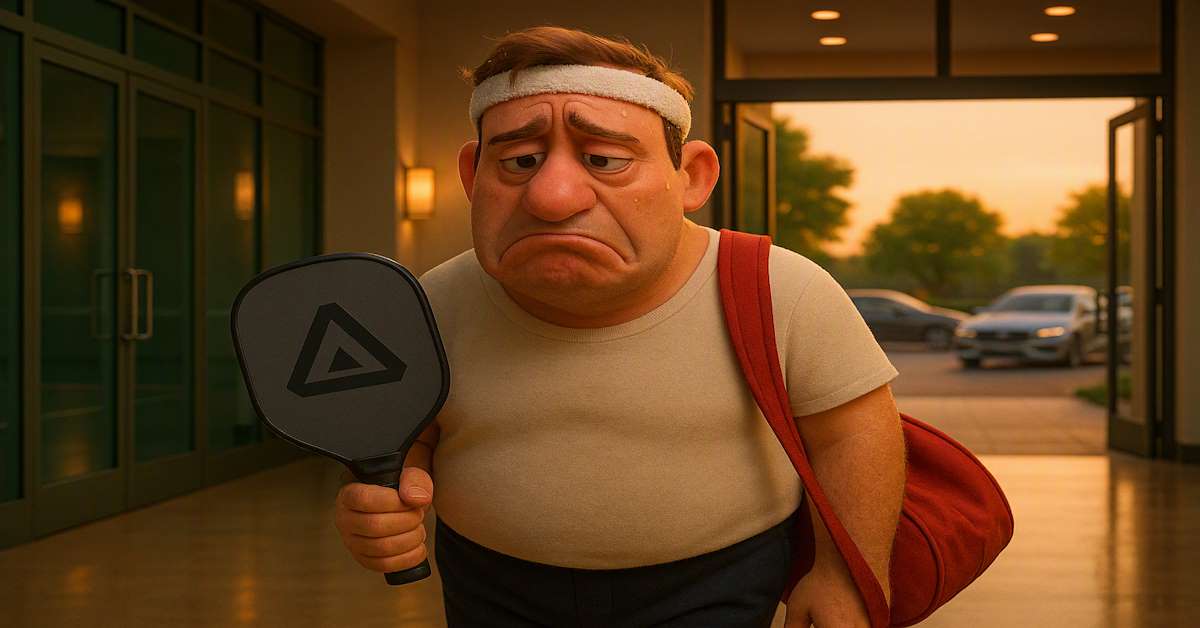
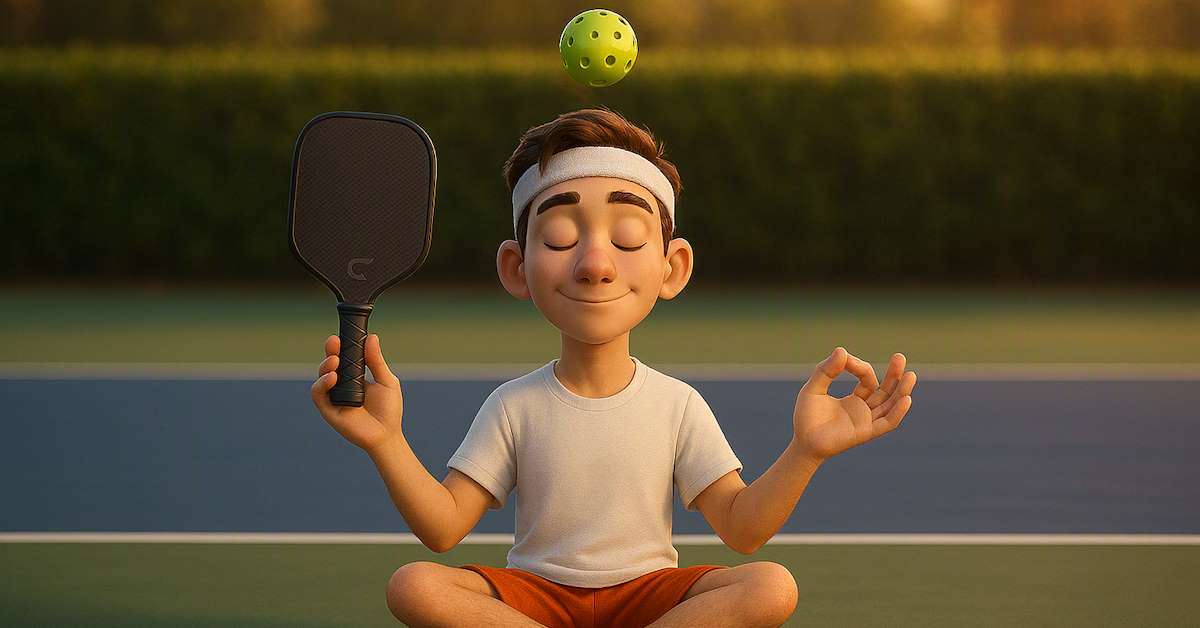
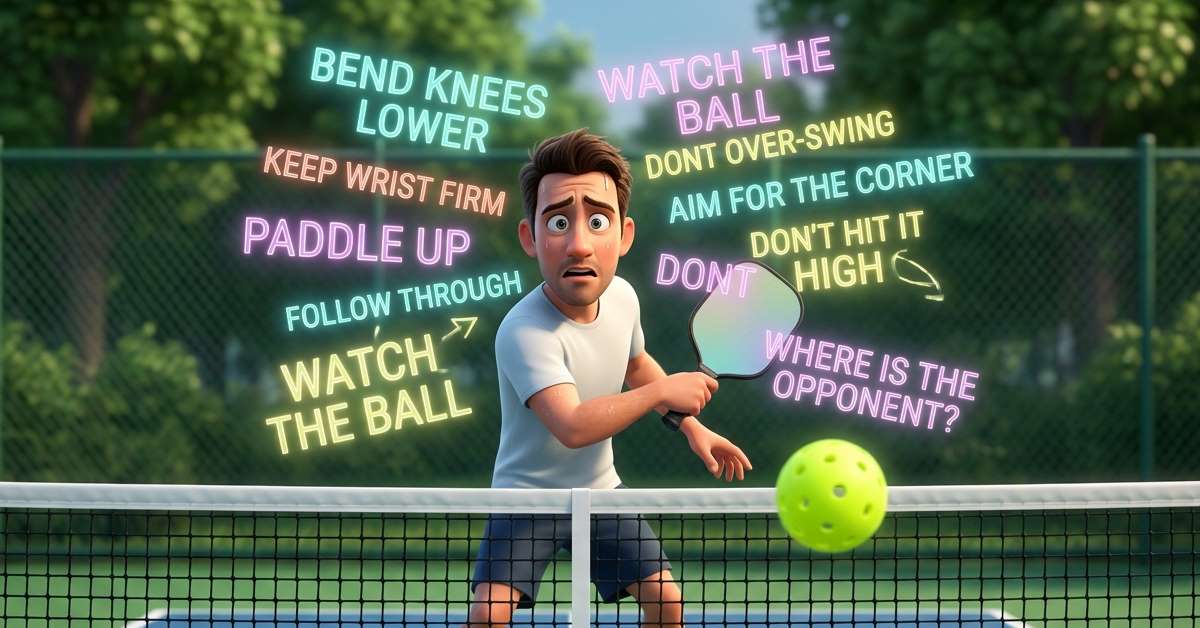
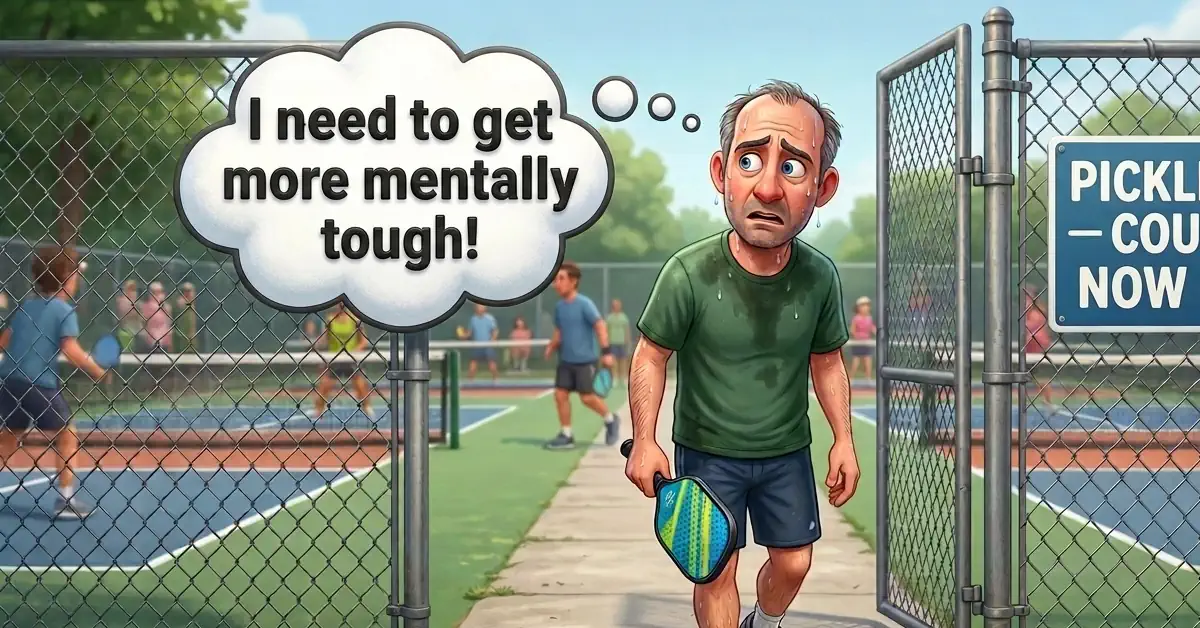
Stop Playing Tight: How to Kill Match Anxiety Before You Even Step on the Court
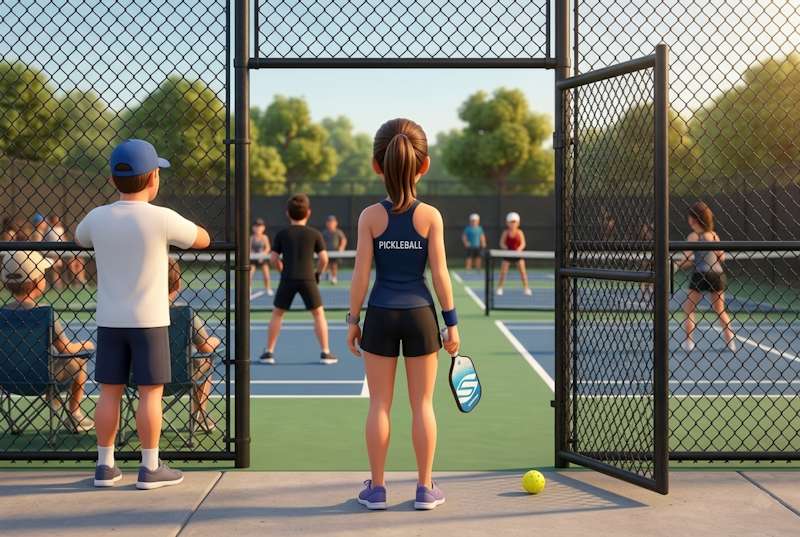
The Ultimate Pickleball Pregame Routine for Mental Toughness
Mental toughness does not start when you strike your first dink; it begins the moment you decide to play. A solid pickleball pregame routine sets a psychological foundation before you even arrive at the courts, so you don’t start the match in a state of chaotic reaction.
Think of your mind as your most important piece of gear.
You wouldn’t play with a cracked paddle, yet many players walk onto the court with a cluttered, anxious mind and wonder why their third-shot drops are hitting the net. By preparing your mindset hours before play, you clear the mental static so your natural muscle memory and love for the game can flow freely.

The Night Before: Cognitive Offloading to Clear Your Mind
Original Concept: Anxiety loves unorganized thoughts. Before bed, pack your gear bag, lay out your court clothes, prepare your hydration bottles, and establish your glucose loading plan. Deliberately review your technical goals for the next day.
Offloading these trivial logistics frees your working memory so your brain can enter deep, restorative sleep.
- The Coach’s Perspective: When you leave logistics to the last minute wondering where your favorite paddle is, if you have enough clean socks, or how you will fuel your body, your brain stays on high alert.
Think of packing your bag, mixing your electrolytes, and staging your clean carbohydrates the night before as emptying a heavy backpack. You are telling your mind, “Everything is taken care of. There is nothing to solve right now.” This ritual quiets your thoughts, ensuring you wake up fresh.
More importantly, it gives your brain the peaceful rest required to cement the physical skills you have been practicing all week.
- The Science Behind It: This practice relies on a psychological phenomenon called Cognitive Offloading, using physical actions to reduce mental workload. Unresolved tasks trigger the Zeigarnik Effect, which is the brain’s tendency to loop intrusive thoughts about incomplete goals.
By packing your bag, you clear your brain’s working memory (its temporary processing power). This lowers activity in the amygdala (the brain’s anxiety center), allowing you to enter deep, slow-wave sleep.
It is during this specific sleep stage that the brain consolidates motor skills, literally wiring your paddle mechanics into your neurological framework overnight.
The Breakdown for the Court:
- Cognitive Offloading / Working Memory: Think of your working memory like a tiny phone screen that can only display three open apps at once. If you are using that limited screen space to remember your court shoes, water bottle, and morning meal, you do not have room for your game plan. Packing and planning the night before closes those extra apps so your screen is clear.
- The Zeigarnik Effect: This is the brain’s annoying habit of leaving the engine running on an unfinished task. If you do not set out your gear, mix your hydration, and map out your fuel, your brain stays awake trying to solve the uncompleted task of getting ready, robbing you of deep sleep.

Neutralizing Imposter Anxiety: Facing Better Players with Tactical Freedom
Original Concept: If you arrive at the courts thinking your opponents are vastly superior, you will instantly play tight and hesitant. You need to reframe the matchup.
Better players are not a threat to your ego; they are an absolute gift to your development. Against higher level players, you do not have to play perfectly, you just have to stay disciplined.
Shift your goal away from winning the scoreboard and focus entirely on making them earn every single point. The pressure is entirely on them to win, which frees you to play with complete tactical freedom.
- The Coach’s Perspective: We have all felt that wave of intimidation when we see an advanced player warming up on our court. Your stomach drops, and your grip tightens.
Change the rules of the game in your head. You do not have to match their power; you just have to be stubborn. When you shift your focus to making them hit one more ball, the psychological weight shifts completely.
The advanced player carries an immense burden to prove they are better. By accepting that the pressure is entirely on them, you unlock an incredible sense of freedom to swing without fear..
- The Science Behind It: Intimidation is a localized form of Imposter Syndrome, which triggers a threat response in the autonomic nervous system, releasing cortisol and adrenaline.
This hormone spike causes muscles to constrict and narrows peripheral vision, ruining the loose wrist required for delicate dinking. Sports psychologists counteract this through Cognitive Restructuring to alter your Self Efficacy, which is your belief in your ability to perform.
Shifting from winning the match to making them work switches your brain from a performance avoidance goal to a mastery goal. This quiets your fight or flight response so your body can move fluidly.
The Breakdown for the Court:
- Cognitive Restructuring / Self-Efficacy: This means rewiring your brain’s internal scoreboard before the match starts. Instead of giving yourself a “pass/fail” grade based on winning the game, your new metric for success is simply: “Did I make them hit an extra ball?”
- Performance-Avoidance vs. Mastery Goals: A performance-avoidance goal is playing scared so you don’t hit a pop-up. A mastery goal is leaning into the kitchen, tracking the ball’s spin, and executing your dink regardless of who is standing across from you.
- Imposter Syndrome: This is the sudden feeling that you do not belong on the same court as your opponents and that your skill level is a fraud. This mental block triggers a physical threat response, causing your body to release stress hormones that tighten your muscles, shorten your breathing, and ruin your touch at the kitchen line.
- The Solution Metrics: When playing better players, your metric is Persistence (make them hit one more ball).
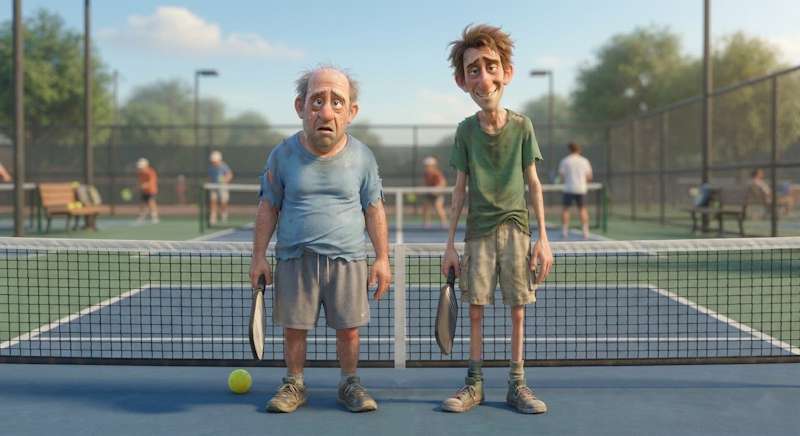
Beating the Complacency Trap: Facing Weaker Players Without Playing Sloppy
Original Concept: Your psychological approach must adapt based on your opponent’s skill level, and complacency against a “should win” opponent is its own trap. When you feel you should easily beat someone, underestimating them causes you to play sloppy, reactive pickleball, often leading to frustrating upset losses.
The Coach’s Perspective: We’ve all been there. You step onto the court against a team that looks less athletic, has unpolished strokes, or has a lower rating, and your brain subtly turns off. You think, “I can coast through this one.”
But then you miss a casual dink, drop a third shot into the net, and suddenly you look up and you’re down 8-3. Now you’re panicking, playing tight, and trying to force heroic shots to catch up.
When you play down to an opponent, you give away your greatest weapon: your standard of execution. As your coach, my rule is simple: respect the game, not the rating.
When playing a weaker team, your goal isn’t just to win; it’s to play clinical, flawless pickleball. Treat every ball they send over with the exact same respect you would give a ball hit by a pro.
The Science Behind It: Losing to a lower-level opponent is a classic psychological trap rooted in complacency induced Attentional Drift and habituation.
When your brain perceives a task as low threat, it down regulates the sympathetic nervous system too much, failing to release enough norepinephrine to maintain focus. Your visual tracking speed slows down, and your footwork becomes lazy.
When you inevitably fall behind, your brain experiences a sudden Cognitive Shock, triggering a massive spike in cortisol. Because you haven’t been dialed in, trying to suddenly turn your focus back on causes you to “over correct,” destroying your fine motor control and leading to a cascade of unforced errors.
The Breakdown for the Court:
- Attentional Drift: This is your mind wandering mid point because you think the match is in the bag. It’s the equivalent of looking up to see where you want to hit a winner before the ball has actually made contact with your paddle face.
- Cognitive Shock: This is the panic that sets in when a team you underestimated gets to game point. Your brain completely freezes up, turning a routine, easy reset into a popped up ball that gets smashed right at your chest.
- The Solution Metrics: When playing weaker players, your metric is Precision (make fewer unforced errors than them, period).
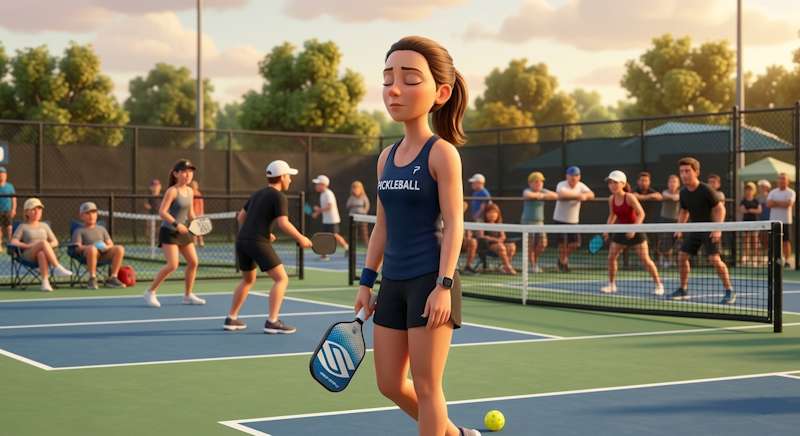
Eradicating Performance Dread: Shifting Your Pickleball Match Preparation to a Process Mindset
Original Concept: The heavy dread of playing poorly or letting down a partner usually stems from focusing entirely on the final outcome. Your brain cannot process tactical mechanics while simultaneously worrying about a hypothetical future failure.
When that stomach sinking dread creeps in, remind yourself that a bad game is not a permanent reflection of your skill, it is just data. You are not stepping onto the court to defend your reputation; you are going out there to execute a sequence of physical movements.
- The Coach’s Perspective: It is completely normal to worry about letting your partner down in a social sport like pickleball. But here is the hard truth: your brain cannot focus on a beautiful paddle angle if it is busy worrying about a bad score line.
Dread happens when we let our minds wander into a future that has not happened yet. Give yourself some grace. A missed kitchen pop up does not mean you are a bad player. It is simply a piece of neutral information.
It tells you that your paddle face was too open or your feet were not set. Strip away the emotional shame, and start treating mistakes as helpful coaches.
- The Science Behind It: Performance dread activates the brain’s Default Mode Network, which is responsible for self rumination and future focused worry.
When this network is hyperactive, it directly suppresses the Central Executive Network, the area required for real time problem solving and visual tracking. Embracing a growth mindset aligns with what psychologists call Cognitive Defusion, which is separating your identity from your behavior.
You are not a bad player; you simply executed an incorrect physical sequence. This shift silences the rumination network, boots up the executive network, and allows your brain to enter a state of athletic flow.
The Breakdown for the Court:
- Cognitive Defusion: This is separating the player from the stroke. If you hit a drive deep into the fence, you don’t think, “I am terrible at drives.” Instead, you look at it like a broken paddle face alignment that needs a mechanical adjustment on the next point.
- Default Mode Network (DMN) vs. Central Executive Network (CEN): Think of the DMN as your “anxious inner critic” and the CEN as your “focused athlete.” They cannot both rule your brain at the same time. When you focus on a physical mechanic, you physically pull the plug on the inner critic.
- Flow: represents a state of optimal performance often called “the zone” where a player’s overthinking mind goes quiet, allowing actions to become entirely instinctual.
This mental state is driven by transient hypofrontality, which silences the brain’s analytical center so muscle memory can take over without emotional judgment during fast-paced rallies.
It occurs at the perfect challenge-skills balance, keeping the player highly focused without slipping into anxiety or boredom.
Ultimately, this deep task absorption alters the perception of time, making rapid exchanges at the kitchen line feel slower and creating a seamless connection between the player, the paddle, and the ball.
- Growth Mindset is the deeply held belief that your court skills, strategic IQ, and physical execution can be continuously developed through dedicated practice, smart strategies, and constructive feedback.
Rather than viewing unforced errors or lost matches as definitive proof of low talent, players with this mindset reframe setbacks as essential data points for technical improvement and tactical adjustments.
This mental approach shifts the player’s focus away from a perfectionist obsession with the final scoreline, instead prioritizing the mastery of specific mechanics such as dink patience, resets, and third-shot drops which ultimately unlocks sustained, long-term athletic development.
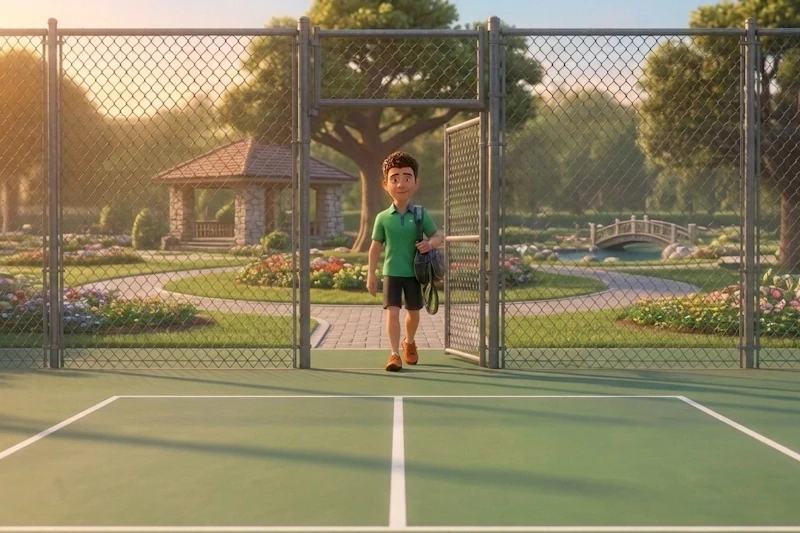
The Visual Walkway: Finalizing Your Pickleball Pregame Routine at the Gate
Original Concept: As you walk to the courts, use your physical environment to ground your focus. If you are playing outdoors, look closely at the court lines and listen to the clean pop of the balls.
If you are playing indoors, stepping into a cavernous, echoing facility can feel like a sensory overload of overlapping noises and harsh lighting. Ground yourself by utilizing the entrance doors as a mental boundary wall.
The moment you pull open those facility doors or step past the outdoor park gate, tell yourself, “Everything outside of this fence stays outside of this fence.” Narrow your vision down from the busy environment and lock your eyes onto the specific dark backdrop of your designated court wall.
This transition routine leaves daily life stress behind, ensuring you enter the playing arena entirely present.
- The Coach’s Perspective: Pickleball courts are loud, chaotic places. Between echoing indoor facilities, shouting from adjacent courts, and bright lights, your focus can fracture before you even hit a ball.
Use your eyes and ears to pull yourself into the present moment. Look at the texture of the net; listen strictly to the rhythm of the balls. When you hit that gate, treat it as a sacred boundary.
Leave your phone worries, chores, and stressors outside. Give yourself permission to just be a pickleball player for the next two hours.
- The Science Behind It: This transition routine utilizes clinical Sensory Grounding Techniques and Stimulus Control. Chaotic environments flood the visual and auditory cortex with data, creating low-grade neurological overwhelm.
By forcing your eyes to lock onto a specific court line or wall, you employ Selective Attention, which filters out irrelevant background noise before it can flood your nervous system.
Furthermore, treating the gate as a literal boundary is an act of Compartmentalization, which allows the brain to temporarily deactivate stress networks associated with daily life, ensuring maximum focus on the immediate task.
The Breakdown for the Court:
- Compartmentalization: Think of your mind like a double-sided paddle bag. One side holds your outside life (work deadlines, bills, family chores), and the other side strictly holds your pickleball game. Stepping through the court gate is the physical act of zipping the life side closed and opening the court side wide.
- Selective Attention: This is your brain’s internal camera zoom. When you walk into an open recreational play area with 12 courts playing at once, your eyes and ears get overwhelmed. By intentionally zooming your focus in on just the weave of your specific court’s net, you completely blur out the chaotic background distractions.
- Sensory Grounding Techniques are rapid mindfulness exercises designed to quiet anxiety, stop overthinking, and pull an athlete’s focus back to the immediate physical environment. In high-speed sports like pickleball, these techniques serve as mental “resets” between points to interrupt panic and trigger athletic flow.
- Stimulus Control is a behavioral conditioning technique where specific environmental cues are used to automatically trigger desired behaviors, thoughts, or mental states. In athletic training, players use stimulus control to strip away conscious overthinking and instantly switch their brains into a state of high focus or athletic flow.

Bonus Section: The Hydration and Fueling Mindset: Powering Your Pickleball Pregame Routine
The Core Concept: Peak mental performance requires physical clarity. Viewing your hydration timeline and glucose loading protocol as a mandatory cognitive tool rather than just a physical chore ensures your brain operates at maximum velocity on the court.
- The Coach’s Perspective: You cannot expect a high performance engine to run on cheap fuel or an empty tank. Many players roll onto the court having only had a cup of coffee, and then wonder why they lose their focus, misread deep lobs, or make lazy errors in the third game.
Hydrating and fueling properly isn’t just about stopping muscle cramps; it is about keeping your brain sharp. When you start sipping your electrolytes and eating clean carbohydrates hours before play, you are actively priming your eyes to track fast paced balls and giving your mind the stamina to stay calm during tense kitchen standoffs.
- The Science Behind It: Mild dehydration, representing as little as a 1% to 2% drop in body water, directly degrades cognitive fluidity and induces prefrontal cortex fatigue. The prefrontal cortex is the executive command center of your brain, responsible for spatial awareness, split second tactical decisions, and emotional regulation.
Furthermore, during intense physical play, your brain relies entirely on steady glycogen reserves to power its neurological pathways. Initiating glucose loading overnight or three hours pregame via complex, low-glycemic carbohydrates ensures baseline stability.
If you skip pregame fueling, blood glucose levels drop rapidly during exercise, causing an immediate spike in cortisol. This stress hormone surge induces systemic muscle tension, destroying your ability to make precise micro adjustments with your paddle face.
The Breakdown for the Court:
- Prefrontal Cortex Fatigue: This is what happens when you start misjudging whether a ball is flying “out” or landing “in.” When your brain lacks water, your executive center goes offline, turning an easy baseline leave into a panicked, mistimed shoulder volley.
- Glycogen Reserves / Cortisol Spike: When your body runs out of premium fuel (carbs), your brain goes into panic mode and releases stress hormones. On the court, this looks like a player losing their temper, rushing their serve, or getting overly frustrated by an unforced error because their brain is chemically starved.

Conclusion: Guarding the Gates of Peak Performance
The player who wins the mental battle before the first serve controls the tempo of the entire match. Organizing logistics the night before, fueling your mind like a high performance machine, reframing intimidation, guarding against complacency, and using the court gate as a boundary line ensures you arrive fully armored. You are no longer reacting to your environment; you are actively commanding your focus.
Give yourself permission to leave life outside the fence, trust the data your mistakes provide, and let your hard earned muscle memory take over. A professional pregame routine does not buy perfection. It buys presence.
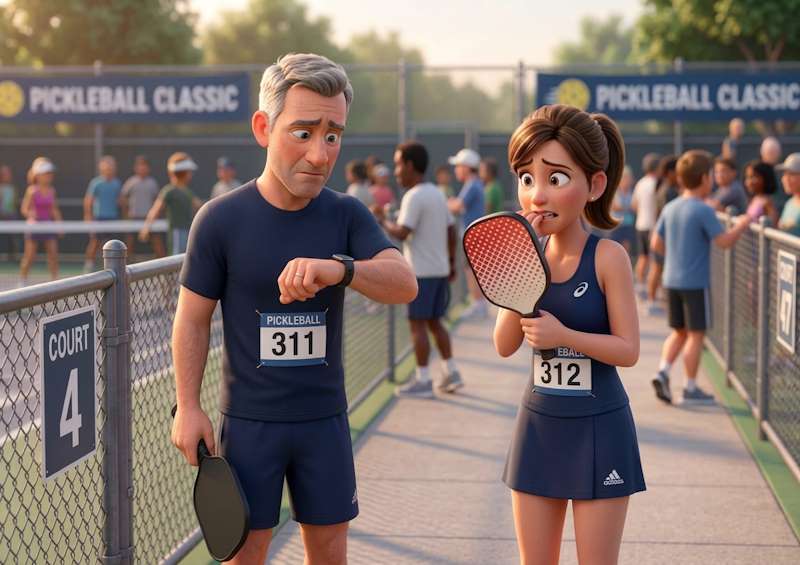
Next Step: Conquering Pre-Match Jitters
You have successfully left the stress of daily life at the gate and stepped into the playing arena entirely You have successfully left daily stress at the gate and stepped into the arena entirely present. However, as you drop your bag, a new challenge stirs: that familiar, fluttering wave of pre-match adrenaline. Your heart rate accelerates, your hands feel cold, and your muscles tighten.
In our next module, Looking Ahead to Mindset #2: Conquering Pre-Match Jitters and Your Physical Warm-Up Strategy, we unpack exactly how to handle these pre-match nerves. We will show you how to channel that anxious physical energy into an explosive asset rather than a mental anchor. You will discover a mindful, structured physical warm up strategy that locks your eyes and paddle directly onto the sweet spot of the ball from the very first rally.
Don’t let courtside nerves freeze your movement before you strike a ball. Click below to discover the exact science backed routines elite tournament players use to quiet their nervous systems, lower their heart rates, and unlock fluid physical execution.
Read About Pickleball Mindset #2: Conquering Pre-Match Jitters and Your Pickleball Warm-Up Strategy