Play the Point, Not the Score: Why Score Amnesia Match Play and Video Review Build a 5.0 Game
My Pickleball Match Video Review Process for a 5.0 DUPR Rating
I’ve felt it in almost every close match: the score takes over. A shank at 9 to 9 feels like a disaster. A clean drop at 2 to 9 barely registers, even though it’s the exact same shot. If I’m serious about reaching a verified 5.0 DUPR rating, I can’t keep letting the scoreboard decide which points I pay attention to. So I’m changing how I play competitive matches, and more importantly, I’m building a pickleball match video review process around how I study them afterward.
What I’m Actually Going to Do During my Pickleball Match Video Review
Starting now, when I play matches that my club records, I’m not going to track or care about the score while I’m on the court. I’ll still play to win each point, but I’m not going to let “we’re down 8” or “match point” change how I make decisions. The score will exist, but it won’t be the thing I’m managing.
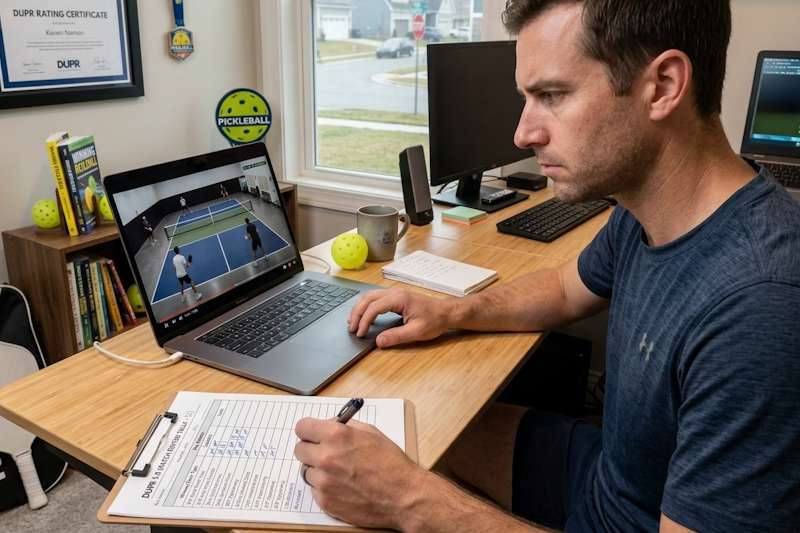
The real work happens after the match, when I sit down alone with the video. Just me, the footage, and a tally sheet I built specifically for this review process. I pick which points to rewind, I decide what I’m looking for, and I score my own decisions before I score my own results. That’s the whole method behind my pickleball match video review.
Why I Stopped Watching the Score During Pickleball Matches
Sport psychology separates goals into three types: outcome goals (win the match), performance goals (hit a stat target), and process goals (execute the right decision or technique on this point). This is where the research on process goals versus outcome goals in sports becomes something I can actually act on: process goals produce a much bigger performance improvement than outcome goals, and they come with less anxiety and more consistency under pressure. That tracks with what I already know about quiet eye and attentional control. Pressure hurts performance most when my attention drifts to the scoreboard instead of the shot in front of me.
There’s a real caveat here, and I want to be honest about it. Not every study agrees process focus wins out once competition starts. Some research finds a more even split between process and outcome thinking in actual match play, and there’s a case that outcome imagery motivates some players. I’m not treating this as settled science. I’m treating it as the better bet for what I actually need right now on the road to a 5.0 DUPR rating, which is fewer unforced errors and steadier technique under pressure, not a new mental trick for match day. That’s what pickleball match video review can do for you, give you real measured results tailored to your style of play.
Analyzing My Pickleball Match Video Review Without a Coach
This is the part I’m most convinced of, and it’s central to how I’m doing pickleball match video review without a coach. Motor learning research on self controlled feedback, where the learner decides when and what to review instead of having someone else direct it, shows a real and repeated advantage. It doesn’t always show up immediately, but it shows up strongly in retention and transfer, meaning the skill actually holds up weeks later in a real match instead of fading after one good practice session. A tennis study using this same setup found players who controlled their own video review improved their tactical decision making significantly more than players who didn’t, and the gap was still there a week later.
I think the reason is simple. When I choose which point to rewind and freeze, I have to diagnose it myself first. That’s an active step. If someone else tells me what went wrong, I skip that step entirely, and I lose the part of the process that actually builds the skill. So for now, this is a solo project. A coach may have a role in my broader training plan, but this particular habit, watching my own match footage and tallying my own decisions during my pickleball match video review session without a coach, stays mine.
Tracking Unforced Errors and Other Metrics on My Tally Sheet
The risk with any review system is that it becomes too heavy to sustain. I don’t need a full breakdown of every shot in the match. I need a small number of categories that tell me the truth about my game, fast enough that I’ll actually fill it in every time.
That’s why I built a one page tally sheet instead of a spreadsheet or a long form. While I’m watching, I mark categories as they happen: whether my third shot dropped or got driven, whether I got caught in the transition zone or advanced cleanly, whether I won or lost the dink rally and how, which shot broke down when I made an unforced error, and most importantly, whether the decision itself was good or bad regardless of how the point ended. Tracking unforced errors by shot type this way tells me far more than a final score ever could. I also flag pressure points specifically, so I can see whether my process holds up when the score gets tight, even though I wasn’t tracking it live.
A single point can hit more than one row, and that’s fine. The goal isn’t a perfect record of the match. It’s a running total, week over week, of the handful of things that actually separate a 4.5 from a 5.0: shot reliability, sound decisions, and consistency when it matters.
My Pickleball Mental Game Plan Going Forward
Every match my club records becomes review material. I’ll watch within a day or two, before I start telling myself a story about how the match went that isn’t backed by what’s actually on the tape. I’ll fill in the tally sheet myself, tally the totals, and look for patterns over time rather than judging any single match. Over a few months, that turns into real data on my own game: which shot breaks down under pressure, how often my decisions are actually sound even when the point is lost, and whether my ready position holds up as matches get longer.
This process is becoming a core part of my pickleball mental game, alongside the physical training and drilling that make up the rest of my plan. None of this replaces coaching, drilling, or match play itself. It’s the layer that makes all of it count for more, because it turns every recorded match into a chance to see my own game clearly instead of just remembering how it felt.
Please feel free to use my pickleball match video review tally sheet for your own match review. Its easy to use with simple tally marks and can be done quickly while watching match video.