Tape Don’t Lie: Video Match Review and the Science of Cognitive Court Mastery
The Truth on Tape: Why Video Match Review Wins the Mental Game
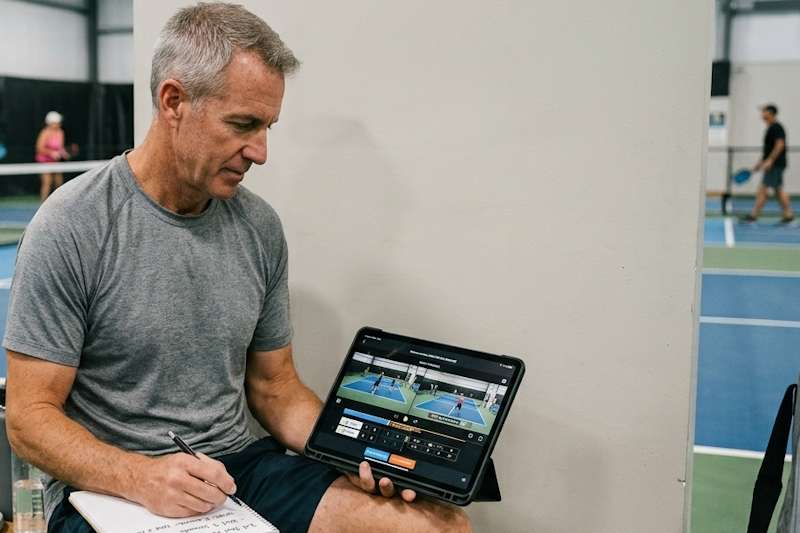
For intermediate pickleball players stuck at the 3.5 or 4.0 mark, breaking through to the upper tiers of competitive play requires a completely objective look at your performance. You cannot fix an error you cannot see clearly. To achieve a true behavioral breakthrough, regular video match review must become the fundamental cornerstone of your development strategy. True development happens when you bridge the gap between what you think you are doing on court and what is actually happening.
💡 Check Your Local Courts: Want to implement regular video match review without the hassle of setting up tripods or draining your phone battery? Ask the front desk at your indoor facility if they record games through Live Pickleball Courts or another recording system. This top tier system rolls twenty four hours a day, allowing you to easily look up your matches online, download your footage, and review your cognitive performance right from home.
Using Video Match Review to Expose Psychological Lapses
When you systematically study your own game tape, you quickly discover that your worst mechanical mistakes are not physical failures at all. Instead, they are direct symptoms of hidden psychological lapses. Looking at your play on a screen allows you to step away from the chaotic emotions of the scoreboard and view your habits like a cold engineering puzzle.
A structured video match review highlights exactly where you lose your cognitive focus. It exposes the precise moments when destructive in game chatter or lingering post shot frustration causes you to rush a rally. For a 3.5 or 4.0 player, reviewing footage catches the split second hesitations that lead to unforced errors, helping you build the absolute patience and mental stamina needed to outlast your opponents. By integrating regular recording into your training, you stop guessing and start engineering your actual progress.
Decoding the Anatomy of a Court Lapse
When you watch yourself frame by frame, look past the ball and focus entirely on your physical responses to stress. Notice your posture right after a missed shot or an opponent’s lucky line drive. If you see yourself dropping your shoulders, shaking your head, or rushing your hand toward your paddle, you are witnessing the physical manifestations of a mental breakdown.
These subtle visual cues prove that your body mind connection has fractured. The mechanical error on the next rally is not due to bad form or a poor paddle sweet spot. It happens because your brain is still stuck processing the frustration of the past point. Recording your games removes the subjective excuses and forces you to confront the reality of your cognitive endurance.
Engineering the Five Second Reset Protocol
Once your video match review isolates these psychological triggers, you can use that data to anchor your in game performance routines. Use the footage to track how long it takes you to recover your composure after a mistake. If you notice your focus wandering for three or four consecutive points, you need a strict, time bound routine to snap your mind back into execution mode.
This is where you implement a standard five second reset routine. The moment a rally ends, immediately wipe your hand on your paddle, take a deep inhale followed by a sighed exhale, and repeat a single focus word like serve in, deep return, or laser focus. By practicing this sequence deliberately during your training sessions, you train your brain to clear out cognitive noise before the next ball is even called.
Overcoming Cognitive Fatigue Past Age Fifty
As a mature competitive player, the nature of the mental game changes. Physical reflexes may shift, but your capacity for strategic processing can expand if you protect your cognitive energy. On game footage, pay special attention to the third game of a match or the fourth hour of a long session. This is where mental fatigue sets in, masquerading as poor technique.
When your brain tires, your quiet eye fixation shortens. Your gaze wanders, your tracking slows, and you begin reacting to the ball late. This is not a failure of your shoulder or your wrist; it is your nervous system running low on stamina. Identifying these fatigue markers on tape allows you to adjust your breathing patterns and pacing between points, ensuring you preserve your processing capacity for critical moments.
Transitioning from Outcome to Process Tracking
The final shift for a competitive player over 50 is changing what you look for when analyzing your footage. Stop counting how many points you won or lost on a specific side of the court. The scoreboard is a chaotic variable that you cannot completely control. Instead, count the number of times you successfully maintained your reset routine, stayed locked into your focus word, or entered a true state of flow.
True court dominance belongs to the player who can outlast their opponent mentally. When you use your recordings to track process oriented execution rather than point outcomes, you build an unshakeable psychological foundation. You stop reacting to the external pressure of the match and start controlling the internal cadence of your entire game.