The Zero Percent Day: Surviving the Court When Your Brain is Trapped in the Real World
The other day, I walked onto the pickleball court directly after studying my articles on mindset. The irony was almost comical. There I was, fresh off writing a new article detailing exactly how to master the mental game, handle adversity, and channel positive energy.
And I felt like complete garbage.
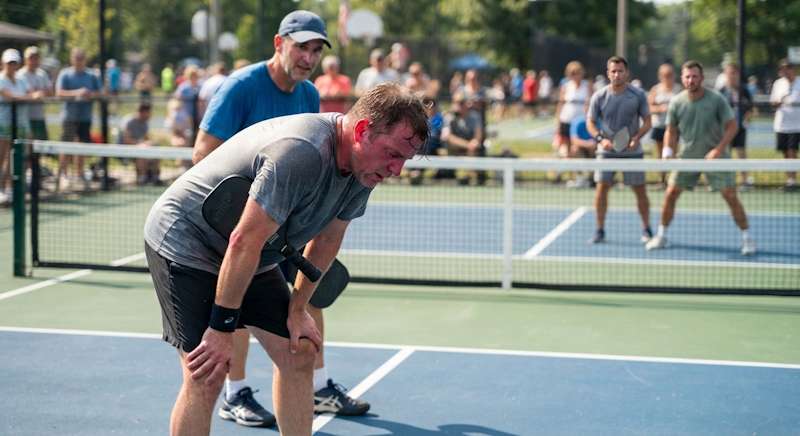
Before I even laced up my court shoes, I knew I was in trouble. My legs were tired, my shoulders were aching, and a heavy, sluggish fog had settled deep into my brain. I quickly realized that playing pickleball tired is a completely different mental battle. The real world had chewed me up, and the physical aches and pains were a loud, impossible to ignore reminder that my battery was sitting at absolute zero.
But I did what most of us do: I pushed through. I forced myself onto the court anyway.
Predictably, it was a disaster. My feet felt like cement blocks glued to the asphalt. My reaction time was a full second behind the ball. Because my physical body couldn’t execute what my brain knew it should do, I spiraled into a vortex of deep frustration. Every missed dink and popped-up drive felt infuriating.
It was a classic “Zero Percent Day.” And it taught me that when your physical body completely rebels, your standard mindset tools are useless. You cannot think your way out of biological exhaustion. Here is how I survived that session, and how you can survive yours without beating yourself up over the setback.
The Ultimate Survival Guide for Playing Pickleball Tired
We live in a culture that glorifies constant, upward progress. We treat ourselves like smartphones expecting that if we just plug ourselves into a wall for a few hours, we should wake up at 100% capacity every single day.
But humans are complex biological organisms, not machines. Expecting peak performance every time you step inside the white lines is statistically impossible.
On that rough day, I had to completely redefine what “maximum effort” meant while managing pickleball physical fatigue. I realized that if my body only had 20% to give, and I dragged every ounce of that 20% onto the court, I was technically giving 100% of my available reality. It is deeply unfair to measure today’s fatigue against last week’s peak. There is a massive difference between pushing through a tough moment and forcing a performance that your body physically cannot deliver. Forcing is just ego disguised as discipline.
The Anatomy of Pickleball Physical Fatigue and Mindset Traps
When life drags you down, the stress doesn’t magically vanish when you cross the court baseline. It sits squarely on your shoulders. On my zero percent day, external exhaustion completely hijacked my brain’s processing power.
Because my muscles were aching and tired, my positioning was garbage. Because my positioning was garbage, I was constantly reaching for the ball, which led to a cascade of pickleball unforced errors.
That is when the mental trap snaps shut. You start getting angry at your hands, your paddle, and your choices. But the truth is, pickleball mindset tips are not magic spells designed to instantly fix your mood or erase physical pain. On a day like this, your mindset is simply a seat belt. It is not there to make the ride smooth; it is just there to keep you from crashing the car.
Your On-Court Survival Playbook for Low Energy
When you physically do not have it, you have to abandon your standard playbook and switch to low energy survival mechanics. The real trick to overcoming pickleball frustration when your body fails you is to radically shrink your playbook. Here is how I adjusted on the court to get through the matches:
1. Eliminate Unforced Errors with the Center-Third Rule
Choice is your absolute enemy when your brain is fried and your body is sluggish. I stopped trying to hit lines, sharp angles, or clever roll dinks. I shrank the court. I hit almost every single ball right down the deep, boring center of the court. By eliminating options, I saved massive amounts of mental and physical energy and drastically cut down on mistakes.
2. Manage Pickleball Physical Fatigue with a 70% Swing
My timing was completely trash because my body was tired. To counter this, I intentionally slowed down my paddle speed. I stopped trying to drive the ball or hit powerful overheads. I focused entirely on the literal sound and sensation of center-paddle contact, letting the paddle do the work instead of forcing it with my aching muscles.
3. Overcoming Pickleball Frustration by Leaning on Your Partner
I dropped my ego and leaned heavily on my partner. I didn’t try to hide my fatigue. I told them straight up: “I am running on empty today.” I turned myself into a human backboard safely resetting the ball and keeping it in play and let my partner hunt the aggressive points and cover the extra court.
Building a Grace Boundary: Mental Toughness for Bad Days
The hardest part of a zero-percent day isn’t the physical pain; it is the mental self-flagellation. To survive the session, I had to implement the “Bee or Hamster Rule.”
Scientists say bees or hamsters have a memory span of about two to three seconds. On a zero percent day, you need to become that bee or hamster (pick your favorite). Yelling “bee” or “hamster” became my trigger word. I gave myself exactly three seconds to feel the sting of a terrible missed shot, drop my shoulders, take a deep exhale, and completely delete it from my mental hard drive.
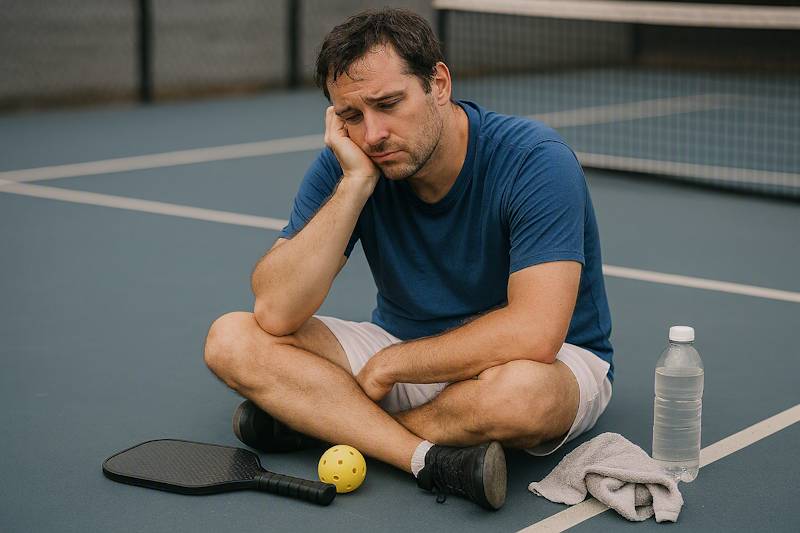
A popped up ball or a missed third shot drop is not a moral failure. It is not a sign that you are getting worse at pickleball. It is simply data. It is your body sending a loud signal saying, “Hey, I am really tired right now.”
Life happens outside the court. Sometimes your brain and body are incredibly busy processing grief, work anxiety, or physical fatigue. The pickleball court cannot always be a sanctuary of peak performance; sometimes, it is just a place where you show up to move your body, and that has to be enough.
Conclusion: Redefining Pickleball Mindset Tips when Running on Empty
True mental toughness isn’t about playing like a god when you feel amazing. Anyone can look like a mental giant when their body is fresh, their mind is clear, and their shots are landing.
Real grit is measured by how gently and intelligently you treat yourself when you are completely in the gutter. It is the ability to look at your aching, exhausted body, lower the bar of expectation to the floor, and say, “We are just going to get through this safely.”
I finished my matches, packed my bag, and went home. I played terrible pickleball, but I survived. If you find yourself standing on the court on a zero percent day, give yourself permission to play poorly. Trust that the tank will refill tomorrow, and remember that sometimes, just showing up is the victory.