Adaptive Play In Pickleball: How Older Players Outplay Injury Risk
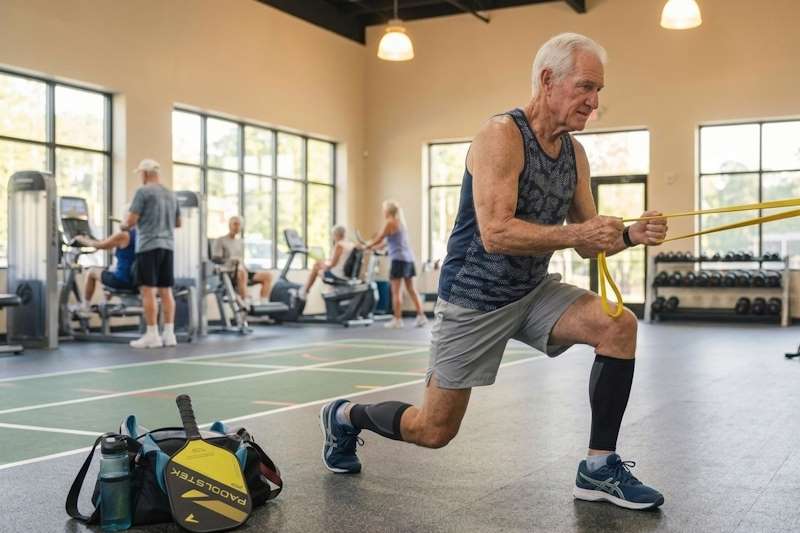
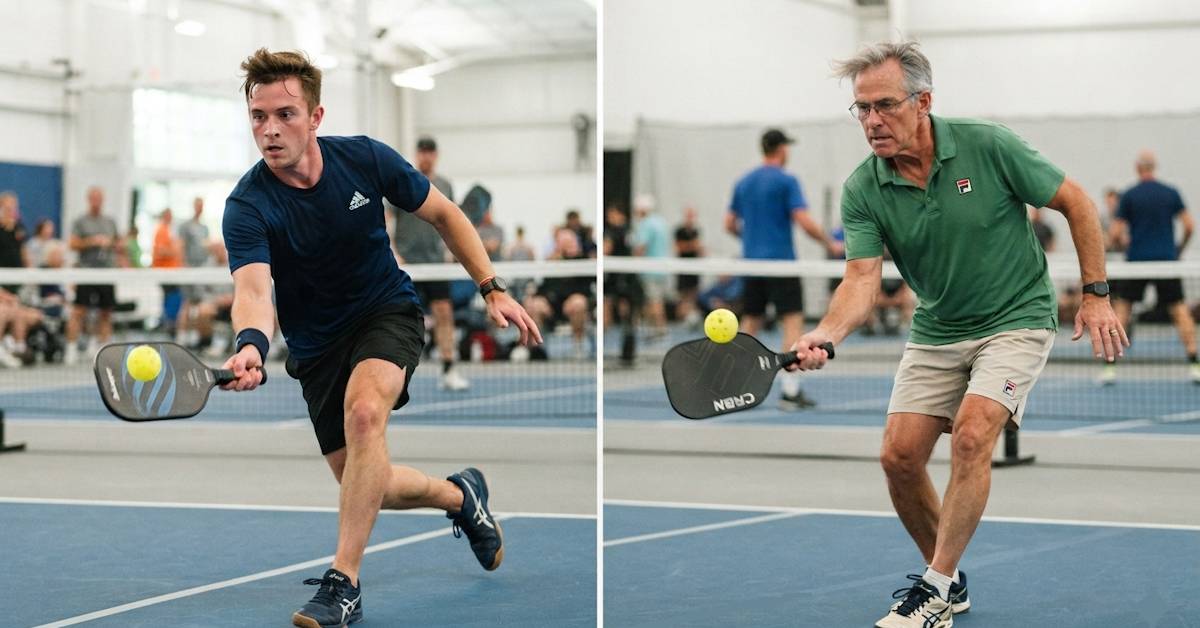
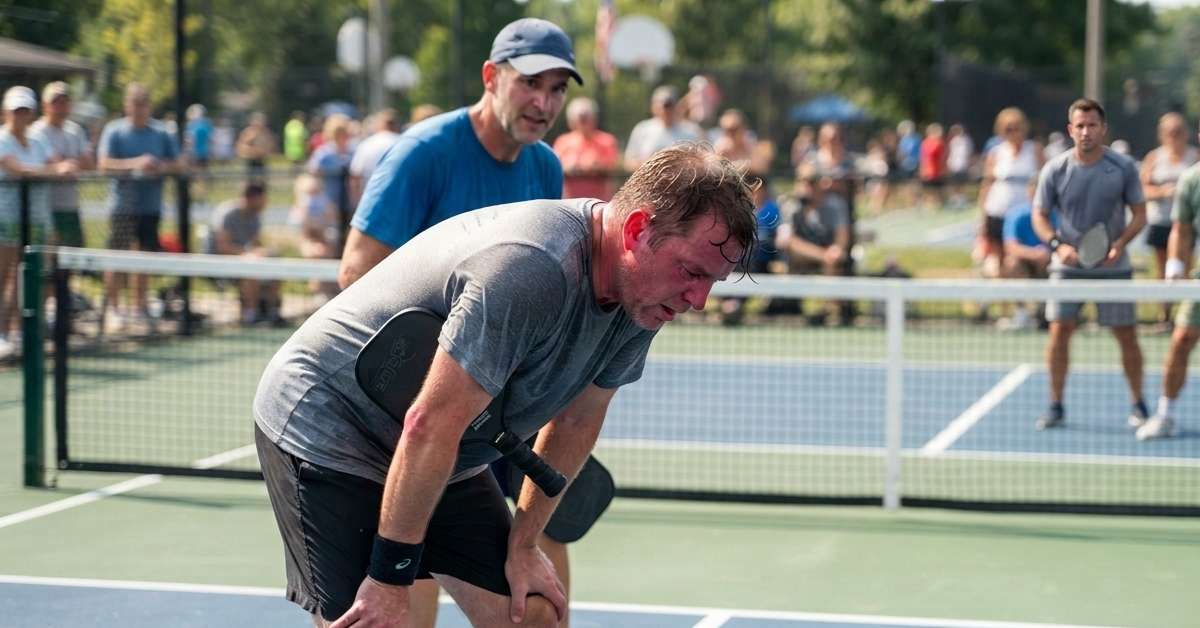
If you only looked at the raw injury numbers, pickleball would look like a young person’s game gone wrong for old people. Players 50 and older account for the overwhelming majority of emergency room visits. The average injured player is in their early sixties. That story is easy to tell and mostly right, but it hides something more interesting underneath it.
Researchers studying a nationwide sample of pickleball players found something that does not fit the simple version of the story. It is sometimes called the adaptive play in pickleball effect: the discovery that the very oldest players in the data, the ones you would expect to be at the highest risk, were not the ones getting hurt the most. That honor went to players in their forties and fifties. The oldest, most experienced players in the sport had learned to protect themselves in ways the data can actually measure.
This is a piece about what those players are doing right, and what the rest of us, regardless of age, can take from it.
The Injury Numbers, Briefly
Our Pickleball Injury Report 2026 covers the full data picture in detail, but here is the short version. Emergency department data collected over a ten year window shows that the overwhelming majority of pickleball injuries happen to players 50 and older, and more recent data narrows that further to the 60 to 79 range. The average age of an injured player, across several studies, lands somewhere between 62 and 67 years old. Players 65 and older who get hurt are also more than twice as likely to end up hospitalized compared to younger players who get hurt.
Part of that is simple math. Pickleball’s player base skews older, so an older population is naturally going to generate more raw injury reports. But raw counts do not tell you whether any individual player’s odds of getting hurt actually go up the older they get. For that, you need a different kind of study, one that looks at odds and predictors rather than totals.
The Adaptive Play In Pickleball Effect, Explained
That is exactly what a team led by researcher Oluwatoyosi Owoeye at Saint Louis University set out to measure. They surveyed 1,758 pickleball players from across the country, with an average age of about 63, and asked about injuries over the past year, along with details on how often they played, how long they had been playing, and how seriously they took injury prevention.
Their results confirmed part of the conventional story and quietly overturned another part of it. Players between 33 and 77 years old had significantly higher odds of injury than the youngest players in the study, those 18 to 32. That tracks with what you would expect. But when the researchers looked specifically at players 78 and older, the pattern broke.
That oldest group showed no significant difference in injury odds compared to the youngest players in the entire study. A separate study on upper body injuries specifically, published through JOSPT Open, found the same flattening: players in their late sixties and seventies, and those 78 and up, showed no meaningfully higher odds of shoulder, elbow, or wrist injury than younger comparison groups.
In plain terms, injury risk climbs through a player’s fifties, sixties, and into the seventies, and then it stops climbing right around the point you would expect it to keep getting worse. That plateau is the adaptive play pickleball effect, and it is a finding about behavior, not biology. Nobody’s joints get more durable at 78. What changes is how the player is using them.
What Was Actually Driving the Difference
The Owoeye team’s data points to three behavioral factors that likely explain the plateau, and none of them are about age itself.
Experience changes how frequency affects risk. Players with less than five years of pickleball experience had 50% higher odds of injury than players with five or more years under their belt. More importantly, experience changed how much playing frequency mattered. A newer player who plays often is taking on real risk. A veteran player doing the same volume is not exposed the same way, because years on the court tend to come with better movement patterns, better court awareness, and a realistic sense of their own limits.
Attitude toward prevention outweighed almost everything else measured. Across the whole study, the single strongest predictor of injury was not age, sex, or how often someone played. It was whether a player rated injury prevention as low or moderate priority. Players who did not take prevention seriously had roughly double the odds of getting hurt compared to players who did, a bigger effect than any other factor in the analysis.
Middle age may work against prevention habits, not for them. The researchers floated a plausible explanation for why players in their forties and fifties showed some of the highest injury rates in the whole dataset: that age group is often juggling work and family obligations that eat into the time and energy needed for a proper warm up or a real recovery routine. The oldest players in the study, many of them retired or with more control over their schedules, may simply have more room to do the things that protect a body during a physical sport.
A separate cross sectional study of pickleball players in South Korea backs up the experience angle from another direction. In that data, players who rated their own skill level higher had meaningfully lower injury risk, and players who logged more hours per week were also less likely to get hurt, the opposite of what you would predict if raw exposure were the main driver. Skilled, experienced players appear to absorb more volume with less cost.
What This Is Not
It is worth being direct about what the data does not say, because it is easy to misread a flattening injury curve as proof that older bodies simply hold up better. They do not. Tissue elasticity, bone density, reaction time, and recovery capacity all decline with age, and that is true whether or not someone plays pickleball. If two players, one 35 and one 78, played identically the same way, with the same intensity, the same frequency, and the same disregard for warm up and recovery, the older player would very likely fare worse.
What the research actually shows is that the oldest players in these datasets are not playing the same way. They have, whether deliberately or through years of trial and error, adjusted how they play to fit what their bodies can currently do. That adjustment, not some biological immunity, is what is producing the flattened risk curve. It is a finding about pacing, preparation, and self awareness, layered on top of bodies that are still aging like everyone else’s.
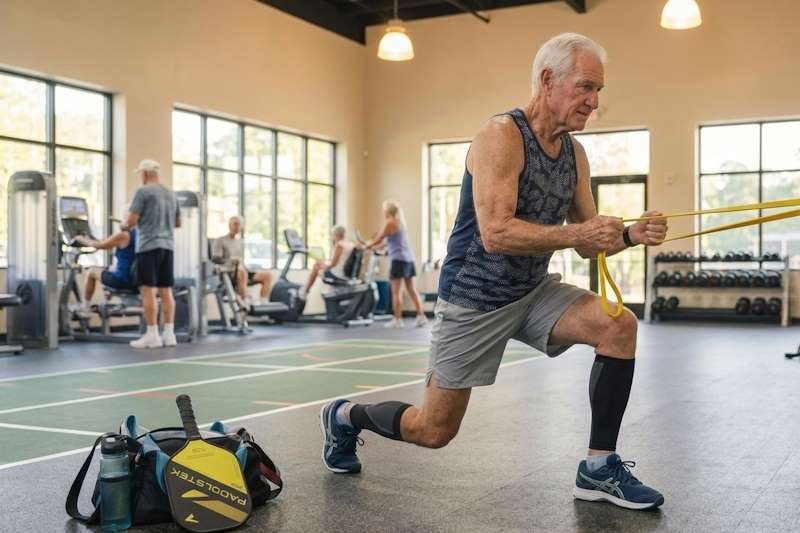
What Every Player Can Borrow From This
The research does not hand us a step by step manual for how the oldest players are pulling this off. Nobody surveyed players on their exact warm up routines or asked them to describe their pacing strategy in detail. What follows is not lifted directly from a study. It is a set of practical extensions built on the pattern the research does show, offered as informed suggestion rather than proven fact. Treat this section as a starting point for your own experimentation, not a prescription.
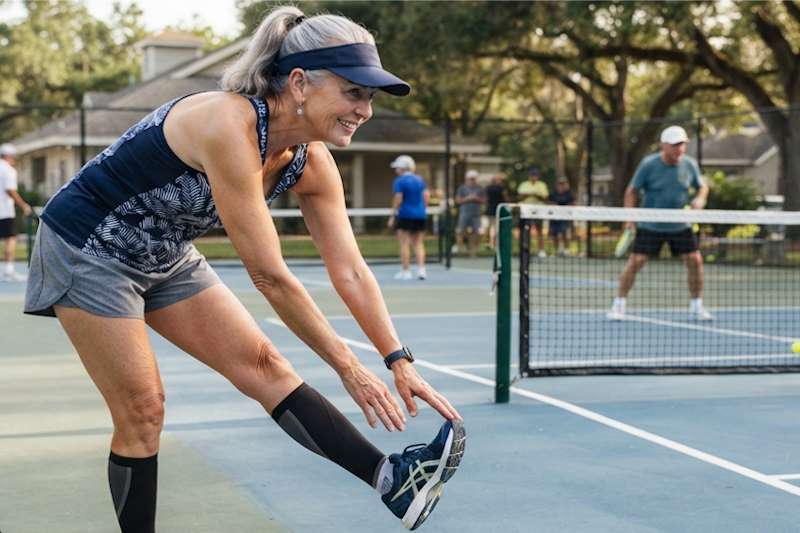
Build a real warm up, and treat it as non-negotiable. If time pressure is part of what works against middle aged players, the fix is making the warm up short enough that it survives a busy schedule. Five to ten minutes of dynamic movement, light jogging, leg swings, arm circles, a few practice dinks, is enough to matter and rarely enough to skip for lack of time.
Let experience do double duty, and if you don’t have it yet, borrow someone else’s. A newer player cannot manufacture five years of court time overnight, but they can shortcut some of what experience teaches by taking a lesson or two, watching how experienced players move and position themselves, and asking a more seasoned partner what they do differently before and after matches.
Rate your own skill honestly, and let that rating guide your pace. The Korean study’s finding that self rated skill tracked with lower injury risk suggests something useful: players who have an accurate read on their own ability tend to make better decisions about how hard to push. Overestimating your skill level probably shows up as overextending for balls you should let go, or playing at an intensity your movement quality cannot support yet.
Take recovery as seriously as you take play. This is likely the most transferable habit in the entire dataset. Older, more experienced players who are avoiding injury are plausibly not skipping the unglamorous parts, rest days between sessions, stretching afterward, paying attention to soreness before it becomes an actual injury. None of that requires age or tenure. It requires deciding it matters.
Treat frequency as a dial, not a fixed setting. Playing three or more times a week was linked to meaningfully higher injury odds across the entire study population, regardless of age. That does not mean cap yourself at two sessions forever. It means treating your weekly volume as something to adjust based on how your body is actually responding, rather than something you lock in and never revisit.
Take your own attitude toward prevention seriously, because the data suggests it matters more than anything else. If there is one single lesson to take from this research, it might be this one. The strongest predictor of injury in the entire nationwide study was not age. It was whether a player considered injury prevention important enough to act on. That is a mindset available to an 28 year old just as much as a 78 year old.
The Bigger Picture
The adaptive play in pickleball effect is a reminder that the sport’s injury story is not simply about who is too old to play safely. It is about who has learned, through years on the court or through deliberate effort, how to play in a way that respects what their body can currently do. Age brings real physical decline, and nothing in this research erases that. But the players posting the best outcomes in this dataset are not winning by being biologically exceptional. They are winning by paying attention, adjusting, and taking prevention seriously long before an injury forces the issue.
For the complete data picture, including injury rates by age, gender, and skill level, along with a full Senior Injury Prevention Plan, see our Pickleball Injury Report 2026.
Sources
- Owoeye O, Yemm T, Blechle R, Wayne M, Kennedy D, Mourad W, Stamatakis K, Howell T. “Understanding Injury Patterns and Predictors in Pickleball Players: A Nationwide Study of 1,758 Participants.” Sports Medicine – Open, 2025. https://link.springer.com/article/10.1186/s40798-025-00900-2
- Bellm C, et al. “Understanding Upper Extremity Injury Prevalence and Risk in Pickleball Players: A Nationwide Survey.” JOSPT Open, 2026. https://www.jospt.org/doi/10.2519/josptopen.2026.0171
- Owoeye O, et al. faculty publication list, Saint Louis University (Doisy College of Health Sciences). https://www.slu.edu/doisy/faculty/owoeye-olu.php
- Injury risk and epidemiology of pickleball players in South Korea, cross-sectional study. Frontiers in Public Health, 2026. https://www.frontiersin.org/journals/public-health/articles/10.3389/fpubh.2026.1898734/full