Negativity Bias in Sports: Why One Bad Shot Ruins Your Whole Game
Negativity Bias in Sports: Why One Bad Shot Ruins Your Whole Game (Even When You’re Winning)
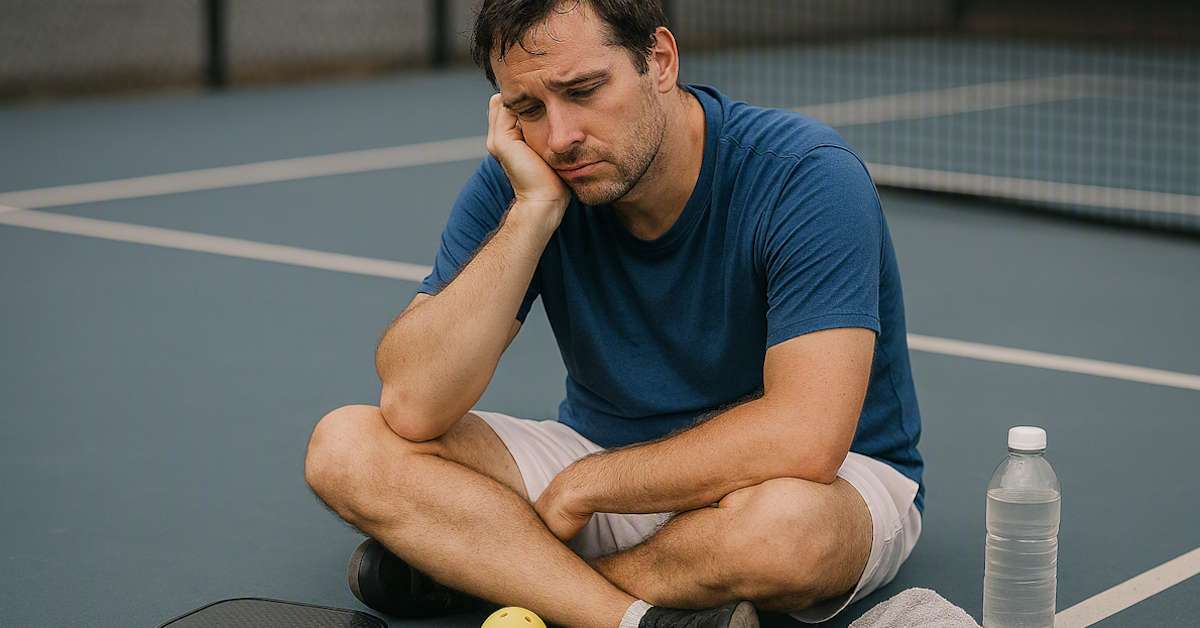
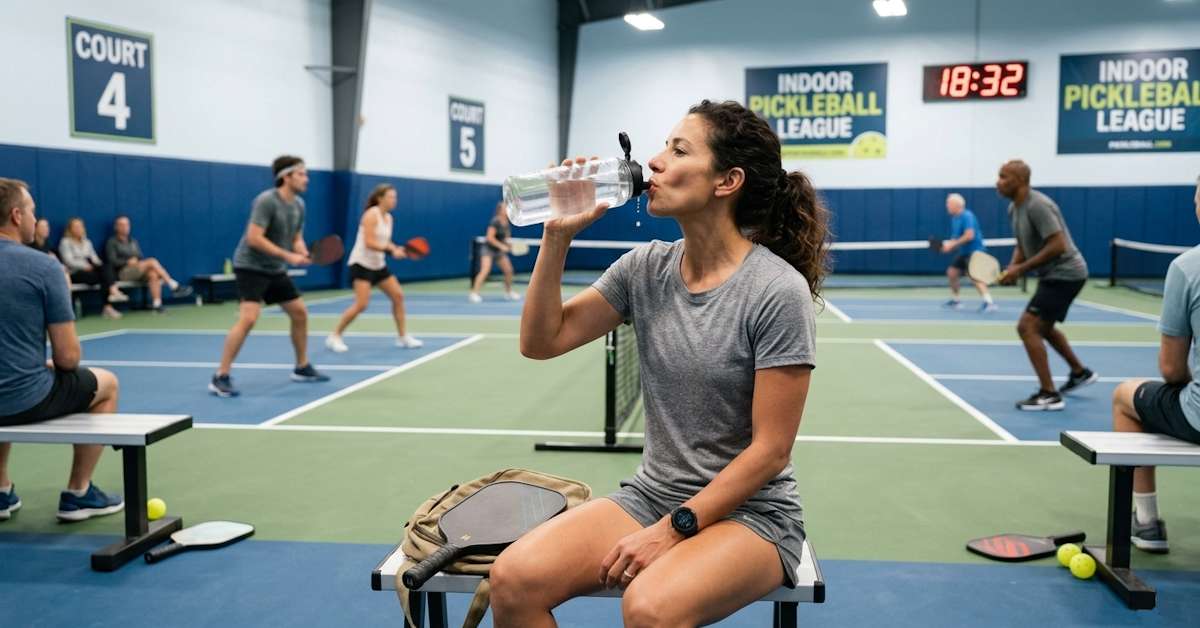
You just had your best week of pickleball in months. Won three out of four matches, hit some ridiculous shots, played well with your partner. Then Saturday rolls around, you sail a simple dink into the net, and suddenly that is all you can think about on the drive home.
Sound familiar? You’re not being dramatic — your brain is literally wired to work this way. Here’s what the science says.
Why the Brain Favors Negativity
This is the starting point for all of it. In one of the most widely cited papers in psychology — “Bad Is Stronger Than Good” (Baumeister, Bratslavsky, Finkenauer & Vohs, 2001) — researchers found that bad emotions, bad feedback, and bad events carry more psychological weight than equally-sized good ones. This showed up in everyday situations, major life events, relationships, and how people learn. The negative just hits harder. Always has.
What that means for pickleball: your brain doesn’t treat a missed shot and a great shot as equal and opposite. The miss gets a bigger file, stored in a more prominent mental folder, with stickier emotional glue.
It’s Not Just You — It Shows Up Specifically in Sport
You might think, “ok, but sports are different — we’re competitive, we’re focused.” It doesn’t matter. A 2024 study specifically on how negativity bias manifests in athletes found three consistent patterns:
- Contagion — one negative moment tends to spread and color the whole experience
- Skewed memory — athletes were more likely to recall negative moments than positive ones, even when the positives were far more frequent
- Attention hijacking — negative events grabbed and held athletes’ focus more powerfully than positive ones
So your brain isn’t just storing the bad shots more vividly — it’s also pulling your attention toward them mid-game, right when you need to be focused on the next point.
Why We Hang Onto Failure: The Deeper Psychology
Here’s where it gets really interesting. Failure doesn’t just feel bad — it actually changes how your brain processes information.
It activates a problem-solving loop that won’t quit. The psychological concept of rumination describes what happens when the brain gets stuck on a negative experience, replaying it over and over trying to “solve” it. The human mind is designed so that when you relive how bad it felt to make a mistake, the brain pulls up other memories of similar mistakes — creating a snowball effect rather than a clean debrief (EBSCO Research Starters, 2024). One missed overhead becomes a mental highlight reel of every missed overhead you’ve ever hit.
Failure is ego-threatening, so we actually tune out. Counter-intuitively, we don’t always learn from failure because it feels so bad that we psychologically check out. Research from University of Chicago Booth School of Business (Fishbach & Eskreis-Winkler) found that participants consistently learned less from failure feedback than from success feedback — not because the failure wasn’t informative, but because “it just doesn’t feel good to fail, so people tune out.” The kicker? When participants watched someone else fail, they learned just fine. It’s the personal sting that shuts down the learning.
Self-criticism makes it worse, not better. A lot of athletes — amateur and elite alike — believe that being hard on themselves after a failure is what keeps them sharp. The research disagrees. A study on athlete recovery from failure found that many athletes report feeling a diminished sense of self and emotional distress following performance failure, and that responding to failure with self-criticism and harsh self-punishment actually undermines self-regulation, emotional recovery, and future performance (Mosewich et al., 2019). So not only does the self-criticism feel terrible, it makes you play worse.
Failure memories compound. Research on rumination shows that when someone relives how bad it felt to make a mistake, the brain turns up other instances where mistakes were made (EBSCO, 2024). That one Saturday dink isn’t just one bad shot in your memory — it becomes a trigger for every shaky moment you’ve stored, amplifying the emotional impact far beyond what the actual event warrants.
The 2:1 Ratio You Probably Feel But Never Knew Was Real
Kahneman and Tversky’s landmark work on loss aversion (Prospect Theory, 1979) found that losses feel roughly twice as painful as equivalent gains feel good. So when you lose a point, you’re not just losing a point — emotionally, it costs about twice what winning that same point would have earned you. Stack that across an entire game, and it’s almost mathematically impossible to feel as good about a close win as you feel bad about a close loss.
What Happens Inside Your Head During the Game
This is where things get especially tough for amateur athletes. It’s not just that we dwell on failure after the fact — the negative thoughts actively invade mid-match and mess with our performance in real time.
Negative self-talk follows bad moments like clockwork. A study by Hatzigeorgiadis and Biddle (2008) tracking competitive athletes found that negative self-talk was directly triggered by lost points and poor performance moments. The worse the gap between where you wanted to be and where you are, the louder the inner critic gets. And once those thoughts start, they’re hard to shut off — cognitive anxiety intensity had a strong relationship with negative self-talk, meaning the more anxious you feel, the more your internal voice piles on.
That inner voice steals your working memory. This is the mechanism that explains why one bad shot can spiral into three or four. Research in sport psychology (Van Raalte et al., 2016) found that the mental energy consumed by negative self-talk depletes cognitive resources — the same mental bandwidth you need to read your opponent, position your feet, and execute the next shot. Essentially, your inner critic and your athletic brain are competing for the same limited processing power, and the critic often wins.
Anxiety literally makes you see threats everywhere. A 2025 study on competitive athletes found that anxiety causes athletes to pay heightened attention to negative and threatening information during competition. So after a missed shot, you’re not just dealing with one bad moment — your brain shifts into a threat-detection mode that makes the next difficult shot look even harder, your opponent look even sharper, and the situation feel even more dire than it actually is.
Choking isn’t a character flaw — it’s a documented neurological response. Research on choking under pressure identifies what’s happening in the brain: cognitive anxiety consumes working memory resources, leading athletes to over-consciously control skills that are normally automated (Beilock, 2010). A professional tennis serve or a routine pickleball third-shot drop is smooth when it’s on autopilot. The moment you start thinking about it mid-motion — because a negative spiral has pulled your attention inward — that automated skill breaks down. Studies on choking found that athletes with high performance-related anxiety showed significantly stronger neural responses to errors when being evaluated, meaning their brains were treating routine mistakes as alarms rather than data.
And the inner voice feeds itself. A study on gymnasts found that negative self-talk during competition directly predicted higher cognitive anxiety, which in turn predicted more negative self-talk — a closed loop (Theodorakis et al., 2022). Performance was negatively predicted by negative situational self-talk, and positively predicted by positive self-talk. In other words: the spiral is real, it’s measurable, and it’s self-reinforcing.
The Takeaway (For Now)
None of this is a personal flaw — it’s a well-documented feature of human cognition that evolved to keep us alert to threats, not to help us enjoy Tuesday-night doubles. The negativity isn’t irrational; it’s just misfiring in a context where it does more harm than good.
The research is clear that this pattern is real, it’s universal, and it operates both between games (in how we remember and dwell on failure) and during games (in how it hijacks attention, depletes cognitive resources, and compounds in real time).
In a this post, we dig into what the research says actually works to counter it.
References
Baumeister, R. F., Bratslavsky, E., Finkenauer, C., & Vohs, K. D. (2001). Bad is stronger than good. Review of General Psychology, 5(4), 323–370. https://doi.org/10.1037/1089-2680.5.4.323
“How negativity bias is manifested in sport.” (2024). Journal of Exercise, Movement, and Sport (SCAPPS). https://www.scapps.org/jems/index.php/1/article/view/3594
Fishbach, A., & Eskreis-Winkler, L. “Not Learning From Failure — the Greatest Failure of All.” Psychological Science. Via University of Chicago Booth: https://news.uchicago.edu/story/why-you-may-learn-less-failure-success
Mosewich, A. D., et al. (2019). Self-Compassion and Psycho-Physiological Recovery From Recalled Sport Failure. PMC/NCBI. https://www.ncbi.nlm.nih.gov/pmc/articles/PMC6624795/
Kahneman, D., & Tversky, A. (1979). Prospect Theory: An Analysis of Decision under Risk. Econometrica, 47(2), 263–291.
“Rumination (psychology).” EBSCO Research Starters. https://www.ebsco.com/research-starters/social-sciences-and-humanities/rumination-psychology
Hatzigeorgiadis, A., & Biddle, S. J. H. (2008). Negative self-talk during sport performance: Relationships with pre-competition anxiety and goal-performance discrepancies. Journal of Sport Behavior.
Van Raalte, J. L., et al. (2016). Self-talk: Research challenges and opportunities. Frontiers in Psychology. https://www.frontiersin.org/journals/psychology/articles/10.3389/fpsyg.2023.1210960/full
Theodorakis, Y., et al. (2022). Positive and negative spontaneous self-talk and performance in gymnastics. PMC/NCBI. https://www.ncbi.nlm.nih.gov/pmc/articles/PMC8947089/
“Effect of attentional bias modification on pre-competition anxiety in athletes.” (2025). PMC. https://www.ncbi.nlm.nih.gov/pmc/articles/PMC12409969/
Hajcak, G., et al. (2016). Neural correlates of choking under pressure: Athletes high in sports anxiety monitor errors more when performance is being evaluated. Journal of Sport and Exercise Psychology. https://www.tandfonline.com/doi/full/10.1080/87565641.2016.1274314