Crunch-Time Focus: The Match Point Strategy Elite Players Use to Close Out Tight Games
Master Your Pickleball Match Point Strategy to Defeat Crunch-Time Pressure
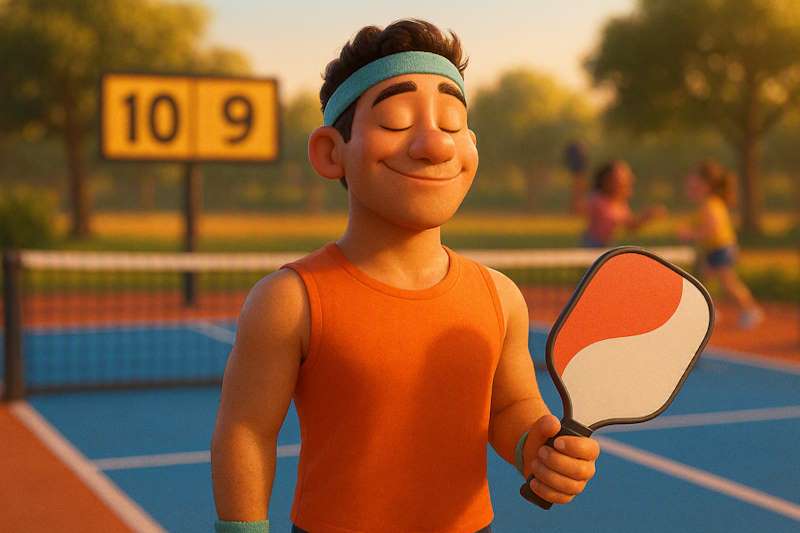
There is a profound psychological shift that occurs on the court the exact moment the score reaches double digits and victory is a single point away. Standing at the baseline with the ball in your hand at 10-9 triggers an intense wave of physiological stress that can cause even the most experienced players to completely freeze up.
Far too many intermediate competitors fight beautifully through an entire match, only to let crunch-time panic alter their stroke mechanics, cause tentative movement, and lead to devastating unforced errors right at the finish line. Learning how to handle pickleball pressure during these definitive rallies requires you to abandon the paralyzing fear of failure and replace it with a hyper-focused operational checklist.
Executing a disciplined pickleball match point strategy is not about inventing a miraculous new shot; it is about protecting your standard of execution under maximum emotional load. By understanding the biological mechanics of choke-pressure and shifting your focus from the final scoreboard outcome to a single, clear tactical intent, you safely insulate your nervous system against high-stakes anxiety.
Instead of letting match-point dread paralyze your reflexes or speed up your internal clock, you maintain complete clarity of mind, allowing you to trust your muscle memory and confidently close out tough victories.
Overcoming Match-Point Freeze: How to Handle Pickleball Pressure and Prevent Choking
The Core Concept: Match-point anxiety physically changes how your brain communicates with your muscles.
By understanding the physiological mechanics of the choke response, you can use active physical releases to interrupt a nervous system freeze and protect your pickleball match point strategy from high-stakes panic.
- The Coach’s Perspective: We have all witnessed the classic match-point freeze, and most of us have felt it firsthand. You get to 10-9, you step up to serve for the match, and suddenly your arm feels like it weighs fifty pounds.
Your grip on the paddle turns into a death-grip, your breathing gets incredibly shallow, and you guide the ball forward tentatively, floating a weak serve that lands short or dumping it straight into the net. You didn’t forget how to hit a serve in the last two minutes; you let crunch-time anxiety paralyze your body.
When you learn how to handle pickleball pressure, you realize that freezing up is a choice to let your fear control your muscles. The absolute second you feel that wave of match-point tension hit your chest, you need to actively shake it out.
Before you call the score, physically drop your paddle to your non-dominant hand, roll your neck, and let your shoulders drop. Take a slow, deep breath and consciously force your fingers to loosen their grip on the handle until it feels light and soft.
Loosening your physical body forces your mind to loosen up, letting your natural athletic swing take over when it matters most.
- The Science Behind It: This paralyzing sensation at match point is a well-documented neurological phenomenon known in sports psychology as Explicit Monitoring Theory, commonly called choking under pressure. When a rally carries high-stakes emotional weight, your brain’s Amygdala interprets the situation as a massive threat to your ego and initiates a sudden fight-or-flight response.
This emotional response forces your Prefrontal Cortex to step in and try to consciously monitor and control your physical movements. Instead of letting your skills run on autopilot, your conscious brain tries to manually guide your wrist angle, your elbow path, and your foot placement.
This explicit interference disrupts the highly complex, automated motor programs stored in your Basal Ganglia, turning a fluid stroke into a stiff, uncoordinated error. To bypass this mental blockade, you must employ targeted somatic releases to reduce your internal Sympathetic Arousal.
Physically relaxing your grip tension and lowering your shoulder carriage sends an immediate neural signal back up to the brain that you are safe. This feedback loop shuts down explicit monitoring, unlocking your motor cortex channels so your hard-earned muscle memory can execute a clean, fluid shot under maximum pressure.
The Breakdown for the Court:
- Explicit Monitoring: This is the act of trying to think your way through a physical movement that you already know how to do on autopilot. It is the exact mental error that causes you to treat a routine third-shot drop like a complex physics equation, resulting in a stiff, mechanical swing that sails way out of bounds.
- Sympathetic Arousal: This is your body’s primitive stress engine going into overdrive. It is the biological force that spikes your heart rate, shorts your breath, and tightens your forearm muscles into a rigid block of stone right before you strike the ball.
- The Grip-Scale Reset: To fight off match-point freeze, use a mental scale of 1 to 10 to measure your hand tension, where 10 is a white-knuckle death grip and 1 is dropping the paddle. As you step up to line up the final serve, consciously squeeze the handle at a 10 for two seconds, and then force your hand to drop all the way down to a loose, relaxed 3. This deliberate physical release instantly breaks the sympathetic lock, restoring the soft touch and fluid wrist snap needed to execute your standard pickleball match point strategy.
Eliminating the Fear of Failure: Shifting Your Focus From the Win to the Process
The Core Concept: Fixating on what will happen if you lose match point triggers a cascade of defensive choices.
By actively shifting your focus away from the final result and channeling it entirely into your immediate tactical process, you disarm the fear of failure and maintain a high-level pickleball match point strategy.
- The Coach’s Perspective: When players step onto the court at 10-9, their minds almost always drift to the wrong destination. They look across the net and start obsessing over the finality of the next rally, thinking, “If we miss this point, it is tied at 10-10,” or “What if I blow this easy overhead smash and cost us the tournament?”
The second you allow your mind to wander into the land of “what-ifs,” you stop playing to win and you start playing not to lose. You become defensive, you play on your heels, and you inadvertently hand the psychological momentum straight over to your opponents.
As your coach, I want you to remember that match point is just another point on a standard pickleball court. The net is still 34 inches high in the center, and the kitchen line has not moved an inch. Banish the scoreboard from your mind entirely.
Do not think about the medal or the victory handshake. Instead, give your mind a strict operational task to focus on, like executing a deep return or keeping your weight forward on your toes. Focus entirely on the work right in front of your face, and let the scoreboard take care of itself.
- The Science Behind It: This strategic pivot relies on moving from an Outcome-Oriented Focus to a Process-Oriented Focus, a shift that drastically alters how your brain handles threat assessment. When you hyper-fixate on winning or losing, your brain enters an Avoidance-Motivation State.
This psychological state activates the Right Prefrontal Cortex, a neural region linked to heightened anxiety, cautious physical movement, and a sudden drop in visual processing speed. Conversely, anchoring your mind to a specific physical task or process triggers an Approach-Motivation State.
This mental state activates the Left Prefrontal Cortex, which suppresses the brain’s internal panic signals, stabilizes fine motor control, and sharpens visual tracking. By consciously choosing to focus on a mechanical process rather than the ultimate result, you strip the high-stakes moment of its emotional threat.
This process-driven approach acts as a structural filter that blocks out performance anxiety, giving you a reliable roadmap for how to handle pickleball pressure when the match is on the line.
The Breakdown for the Court:
- Avoidance-Motivation State: This is the mental trap of playing completely scared. It is the exact survival mode that causes you to hit a soft, tentative dink that stays too high, giving your opponents an easy opportunity to attack and crush the ball directly at your feet.
- Process-Oriented Focus: Think of this as focusing entirely on the ingredients of a recipe rather than the final meal. Instead of wishing for the match to be over, you direct 100% of your mental power into the precise physical mechanics of a single, clean strike.
- The Process Checklist: Before the ball is put into play at match point, run through a quick two-step physical checklist in your head. Whisper to yourself, “Paddle up, feet moving.” Giving your brain these two concrete mechanical tasks to focus on completely starves the fear of failure of the mental bandwidth it needs to paralyze your reflexes.

The One-Shot Clarity Protocol: Locking Down Your Intention Before the Final Serve
The Core Concept: A hesitant, half-hearted choice at match point is far more dangerous than a mechanical error.
By executing a strict, structured decision protocol before you strike the ball, you eliminate mental hesitation, commit fully to your shot selection, and finalize an unshakeable pickleball match point strategy.
- The Coach’s Perspective: The absolute worst thing you can do when the pressure reaches its boiling point is to change your mind mid-swing. I see players step up to hit a third-shot drop at match point, panic at the last microsecond because they see an opponent leaning forward, and try to switch to a hard drive while their paddle is already moving. Thwack. The ball sails three feet past the baseline, and they look back at me in total despair.
As your coach, I am telling you that a bad strategic decision executed with 100% confidence will win more points than a perfect strategy executed with hesitation. Before you call that 10-9 score or prepare to receive, you must execute the “One-Shot Clarity Protocol.”
Look at the court, choose one exact shot type, and pick one exact target area. Once you make that decision, the debate is officially over, and the border is completely closed. Commit to that shot choice with everything you have, swing with full athletic conviction, and live with the result.
- The Science Behind It: This final phase of learning how to handle pickleball pressure relies heavily on minimizing Action Selection Delay and protecting your brain’s Supplementary Motor Area (SMA). When you hesitate or try to process multiple shot options mid-point, your brain experiences severe Cognitive Conflict between the prefrontal cortex and the basal ganglia.
This mental friction triggers a major bottleneck in your neural transmission, causing a visible lag in your motor neurons and making your physical swings look incredibly stiff and jerky. Using the One-Shot Clarity Protocol manually programs your brain’s SMA ahead of time, a region responsible for the internal generation and seamless sequencing of rapid physical movements.
Pre-determining your exact target allows your brain to bypass the complex, time-consuming decision-making loops mid-point. This clean neural processing routes all electrical activity directly into your execution channels, helping you maintain a fluid, unhurried, and highly accurate stroke under maximum stress.
The Breakdown for the Court:
- Action Selection Delay: This is the scientific term for changing your mind mid-point. It is the exact mental glitch that causes your arm to freeze up for a split-second when you can’t decide between a soft drop and a hard drive, resulting in a weak, popped-up ball that gets smashed right at your chest.
- Supplementary Motor Area (SMA) Programming: Think of this as pre-loading a video file onto your computer before you hit play. By deciding on your target before the serve, the physical movie of your swing is already completely loaded and ready to run smoothly without any lag or buffering.
- The Verbal Target Lock: Before you begin the final point, look at your target and silently say the exact shot name in your head. Whether it is “Deep middle” or “Soft cross-court,” speaking the goal out loud locks your mind onto a singular objective, leaving zero room for hesitation to ruin your stroke.
Conclusion: Sealing the Win With Absolute Conviction
Facing a high-stakes match point is the ultimate test of an athlete’s physical discipline and psychological fortitude.
By actively recognizing the biological mechanics of the choke response, using somatic adjustments to break your hand’s death grip, and anchoring your mind to a specific process rather than the scoreboard, you successfully strip the high-stakes moment of its emotional threat.
You do not need to execute a miracle, point-ending highlight shot to win.
Implement a disciplined pickleball match point strategy, commit completely to your target before you step up to the line, drop your shoulders, and swing with absolute conviction to close out the victory.
Looking Ahead to Mindset #10: Post-Match Processing: Dealing with Loss, Bad Play, or a Win
You have successfully navigated the entire psychological arc of competitive play.
You conquered your pre-game jitters, executed a mindful warm-up routine, managed your mid-match stamina, broke through the isolation trap, and maintained your crunch-time focus to battle through the final point of the match.
The referee has called the final score, the paddles have been tapped at the kitchen line, and the physical contest is officially over.
However, as you step off the court and unpack your bag, the final—and often most critical—phase of sports psychology begins: post-match processing.
In our next article, we are going to dive deep into how you mentally process your performance once the dust has settled.
We will unpack the advanced sports psychology secrets behind handling the heavy emotional sting of a tough loss, bouncing back from a day of bad play, and managing the unexpected psychological pitfalls of a big win.
You will discover exactly how to dismantle destructive self-criticism, extract valuable objective data from your mistakes, and build a healthy, sustainable mindset that uses every single match as fuel to elevate your rating.
Ready to Master Your Post-Match Mental Reset?
Don’t let a frustrating loss or a day of bad play destroy your confidence and ruin your long-term progress on the court.
Click the link below to discover the exact cognitive evaluation strategies elite tournament players use to process their results, protect their self-esteem, and bounce back stronger for their next tournament.
Read the Next Chapter: Pickleball Mindset #10: Post-Match Processing: Dealing with Loss, Bad Play, or a Win