Where Your Head Needs to Be: A Guide to Focus in Competitive Pickleball for Players Over 50
Where Focus Goes in Competitive Pickleball, and How Master Athletes Get It Back
Pickleball mental game focus is not something you either have or you do not have. It is something you build, lose, and rebuild over the course of a single match, and if you are competing at 50 or older, the way you manage that focus matters more than it ever did in your twenties or thirties.
Here is the honest truth about most pickleball coaching content out there. It covers footwork, dinking strategy, and paddle selection, but it treats the mental side as an afterthought, something you either have naturally or you do not. Worse, most of the research on older pickleball players focuses on general well being and social connection, not on what actually happens in your head during a competitive match. Only a small fraction of the existing research looks at competitive psychological stability under real pressure, which leaves players like you with a lot of generic advice and not much that is built for what you are actually dealing with on the court.
This matters more the older you get, and here is why. When you were 25, a mental lapse rarely cost you the point. Your reactions were fast enough to bail you out even when your head was somewhere else. That safety net gets smaller every year. A 55 year old competitive player cannot out react a bad decision the way a 25 year old can, which means the margin for mental error shrinks even as the mental demands of competitive play stay exactly the same, or get harder as the stakes rise in tournament settings.
So this guide is not going to hand you a stack of generic mindfulness tips and call it a day. We are going to walk through a match the way it actually unfolds, from the moment you step onto the court to the final rally of a tight third game, and cover exactly where your focus tends to slip and exactly what the research says you can do about it at each stage.
Before the Game: Building Your Mental Foundation
Every competitive pickleball match starts before the first serve. What happens in your body and your head in the thirty minutes leading up to a match sets the tone for everything that follows, and this is doubly true once you are competing past 50.
Anxiety Is Not the Enemy, Panic Is
Here is where a lot of well meaning advice gets it wrong. The goal before a match is not to feel calm. Research on high level padel players, a close cousin of competitive pickleball, backs this up. Pre-competitive anxiety correlates with unforced errors, but the bigger predictor of performance is not how anxious you feel, it is how confident you feel while feeling anxious. Self confidence has a much stronger relationship to performance than simply lowering cognitive anxiety does.
Translation for the court. Stop trying to talk yourself into feeling calm. That is a losing battle and it is not even the right goal. Instead, focus on building confidence that you can execute your game while your heart rate is up and your palms are a little sweaty. Calm is not the target. Capable is the target.
The Physiological Sigh
If you need a fast way to bring your nervous system down a notch before you step on the court, this is the tool worth learning. It is called the physiological sigh, and it works through your vagus nerve, the same pathway responsible for slowing your heart rate and clearing carbon dioxide from your system.
Here is how you do it. Take two quick inhales through your nose, one right after the other, then follow with one long, slow exhale through your mouth. That is it. You can do this in the parking lot, in line for the next open court, or standing at the baseline waiting for your opponent to finish their warm up swings.
The Thirty Minute Routine
A little structure goes a long way before a match, especially once your body and mind need more time to get ready than they used to. Instead of improvising, try building your warmup around this simple sequence:
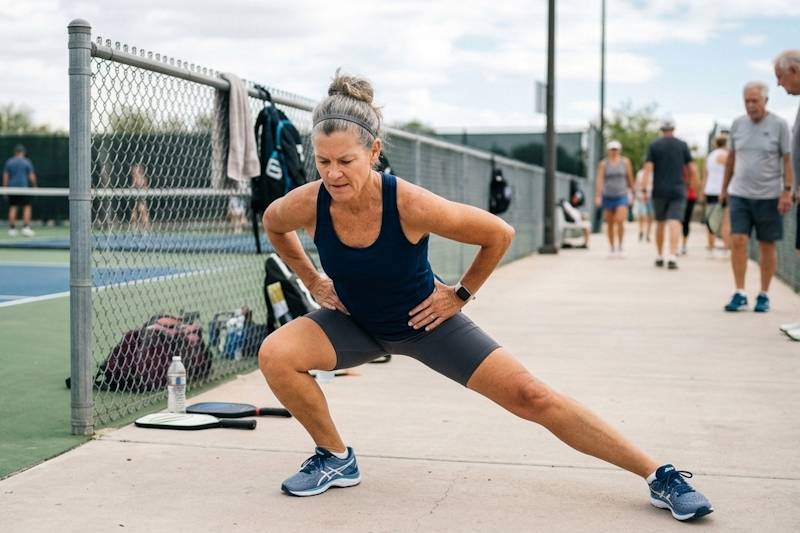
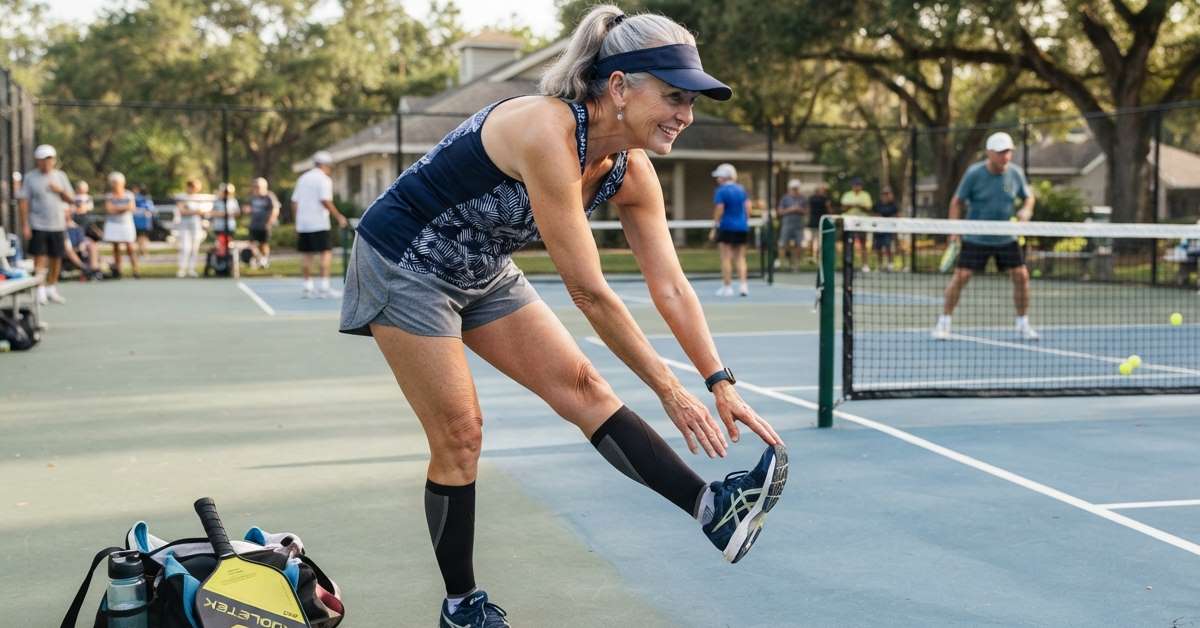
At thirty to twenty minutes before your match, get your body moving. Light aerobic activity and dynamic mobility work, things like lateral swings and leg swings, prime your neuromuscular system and start warming up joints that need more attention than they did twenty years ago.
At twenty to ten minutes before your match, shift to cognitive anchoring. Box breathing, which means inhaling for four seconds, holding for four seconds, exhaling for four seconds, and holding again for four seconds, settles your nervous system. Pair this with mental imagery of clean, center paddle contact. See the shot before you hit it.
At ten to zero minutes before your match, move into on court integration. Get a feel for the ball, and try vocalizing what sport psychologists call a challenge appraisal. Something as simple as saying to yourself, I am excited to compete in this environment, reframes the nervous energy in your body as fuel rather than a threat.
This routine is not about eliminating nerves. It is about making sure that when the first serve comes, your body and your head have already been through a deliberate warm up, not a scrambled one.
Start of the Game: Locking In Your Focus
The first few points of a match set the tempo, and this is where your eyes, not just your mind, start doing a lot of the mental work.
The Quiet Eye Technique
Quiet eye refers to the final moment of steady visual fixation on a target, the ball or a specific target zone, right before you execute a shot. It sounds almost too simple to matter, but the research behind it is not small. Quiet eye training shows a very large effect on the behavior itself and a large effect on actual performance. Stabilizing where your eyes lock in before contact primes your subcortical motor systems, the parts of your brain that run your stroke mechanics on autopilot once you have trained them.
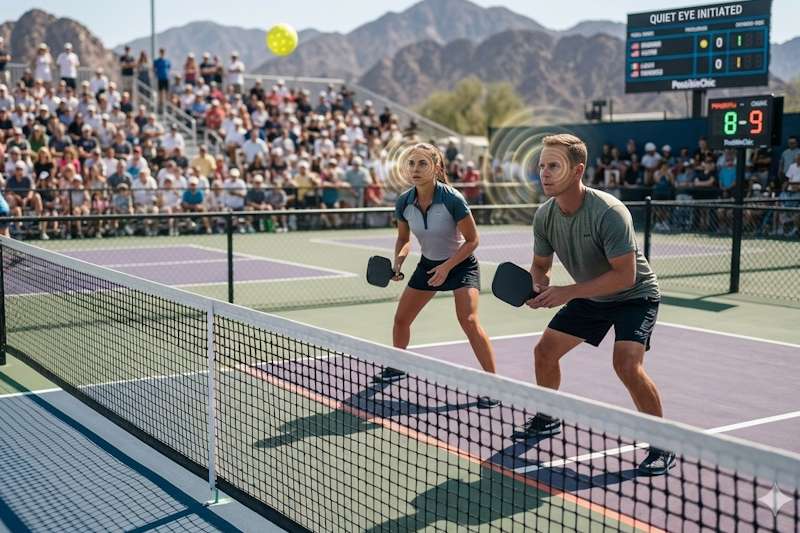
The practical version of this: before you return a serve or set up for a dink, give yourself one deliberate beat where your eyes lock onto the ball or the exact spot you want to hit before you move. Don’t rush that moment it’s doing more work than it looks like it is. That half second is where the rest of the point gets decided.
Internal Cues Versus External Cues
This is one of the more counterintuitive pieces of the research, and it matters even more for players who have spent years refining their mechanics, because you have more habits your brain wants to monitor.
Internal cues are thoughts about your own body parts. Lock the wrist. Keep the elbow down. Check the shoulder angle. These feel like helpful reminders, but they actually work against you. They pull your brain into coaching your own swing in real time, which disrupts the fluid, automatic movement your body already knows how to do and turns a smooth stroke into something rigid and fragmented.
External cues point your attention outward instead. Watch the rotation of the ball. Pick a target zone on the court. Notice the texture of the net cord. These cues unlock the muscle memory you have already built, because they get your conscious brain out of the way of a motion your body has already learned.
| Focus Type | Examples | Performance Impact |
|---|---|---|
| Internal Cues | Lock the wrist, keep elbow down, check shoulder angle | Disrupts autopilot execution, creates rigid mechanics |
| External Cues | Watch the ball rotation, pick a target zone, notice net cord texture | Preserves fluid muscle memory, improves accuracy |
If you catch yourself thinking about your own mechanics mid rally, that is the signal to redirect your attention outward, not inward. Your body already knows what to do. Your job is to stop getting in its way.
This attentional anchor matters even more playing doubles, where you are not just managing your own focus but staying in sync with a partner, something we will get into later in the mid game section.
The Mid Game Grind: Where Focus Breaks Down
This is the longest stretch of a competitive match, and it is where most mental breakdowns actually happen. Not because players do not know what to do, but because fatigue, mistakes, and pressure start stacking on top of each other point after point.
The Error Spiral
A 2026 study on emotional regulation in competitive pickleball identified a pattern that will sound familiar if you have ever watched a match unravel. A mistake happens, that mistake triggers a negative emotion, the negative emotion reduces confidence, and reduced confidence leads to worse decisions on the next point. Each link in that chain feeds the next one, and if nothing interrupts it, one missed shot turns into three or four.
This spiral tends to show up as one of two mindsets. The first is what researchers call the don’t miss mindset, where your attention gets pulled toward the consequences of failing rather than the task in front of you. The second is the fix it now mindset, where you overcorrect, swinging harder or taking on more risk than the shot calls for. Both of these are really the same underlying problem, a failure to treat a negative thought as just a passing thought instead of a technical truth you have to act on immediately. Psychologists call this skill cognitive defusion, the ability to notice a thought without automatically believing or obeying it.
Motor Reinvestment, or Why You Start Choking
Motor reinvestment is the technical term for what most players just call choking. It happens when you start consciously monitoring a movement that used to run on autopilot. Telling yourself to lock the wrist mid rally is a textbook example. That conscious monitoring disrupts the fluid, automatic execution your body has built over years of practice.
Here is the part that matters specifically for players over 50. This mechanical rigidity gets worse the higher the perceived cost of a mistake feels, and for a lot of competitive players past 50, that perceived cost is genuinely higher. You know your body will not bail you out with pure reactive speed the way it might have decades ago, so the pressure to be mechanically perfect creeps in, and that pressure is exactly what triggers the conscious monitoring that ruins your stroke in the first place.
Fatigue Narrows Your Focus
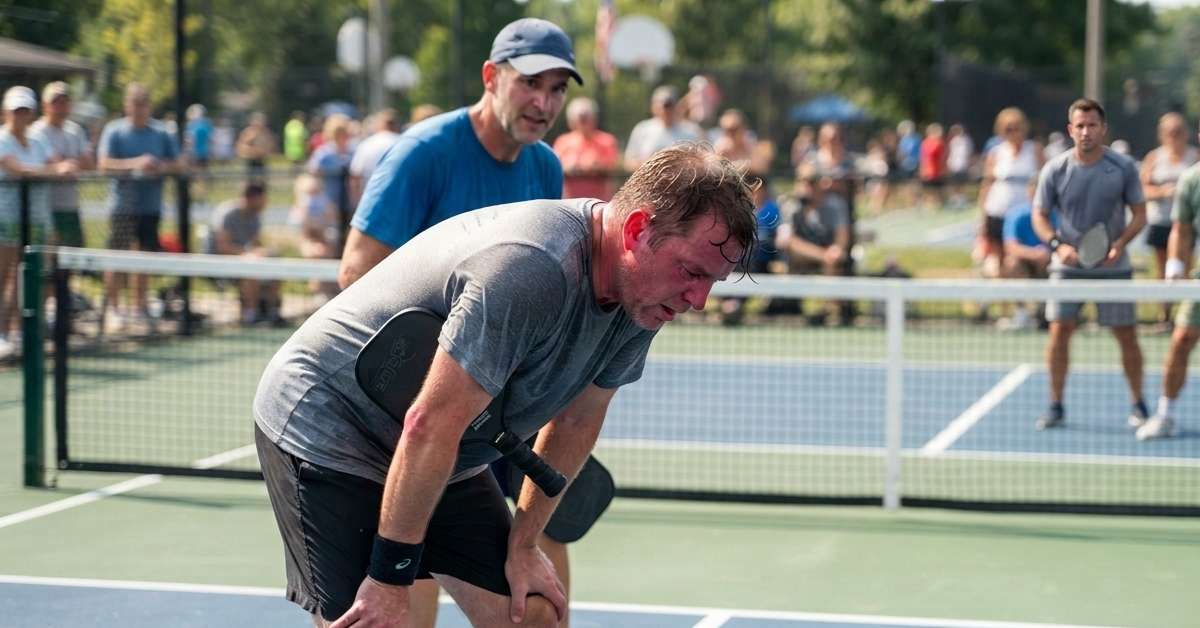
There is a physical piece to this too, and it deserves its own attention. Physical fatigue, which shows up earlier in a match the older you get, causes something researchers call attentional narrowing. Your visual field effectively shrinks, and your ability to process tactical information slows down. Add in the natural age related decline in choice reaction time, the speed at which you can process a decision and act on it, and you get a mid match window where your brain is working with less bandwidth right when the match is asking the most of it.
The practical countermeasures here are straightforward even if they take practice. Position yourself proactively rather than reactively, leaning forward earlier to shorten the distance you need to react across. And as rallies extend and fatigue sets in, simplify your tactical decisions rather than trying to get more creative. This is not the moment to invent a new shot.
The 3-R Reset Protocol
This is the single most useful tool for breaking an error spiral before it snowballs, and it is built around three deliberate steps: release, regroup, refocus.
Release means using a physical action to clear the last point from your system. Something as simple as wiping the paddle face with your hand or tapping your shoe with the paddle works. The action itself is less important than the fact that it is deliberate and physical, not just a mental note to move on.
Regroup means one single diaphragmatic breath, in and out, to reset your autonomic arousal before the next point starts.
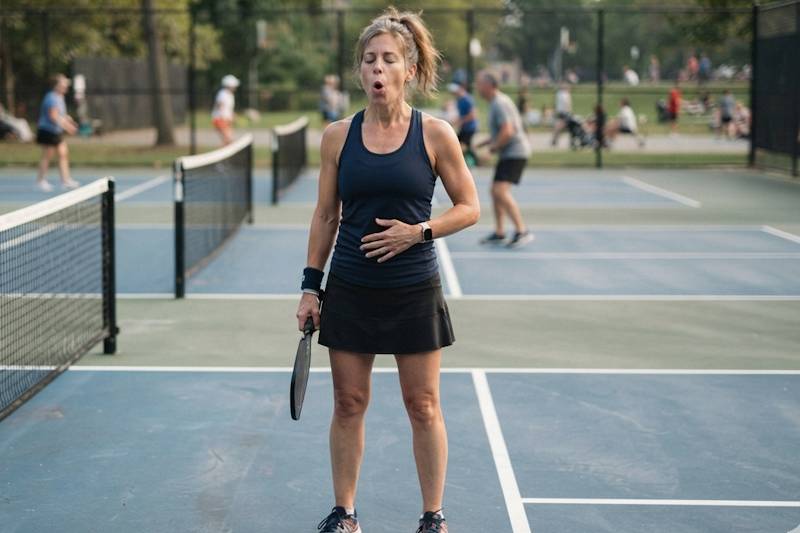
Refocus means giving yourself one short, external, task focused cue, something like see the ball hit the sweet spot, to redirect your attention outward and away from the mistake you just made.
The protocol works best when you have actually practiced it before you need it. Start using it during low pressure drills so it becomes automatic. Then bring it into regular gameplay, using it between every point regardless of how the point went. Finally, test it under simulated high pressure, down 8 to 10, partner missed three shots in a row, so that when a real high stakes moment hits, the protocol already feels familiar instead of foreign.
Doubles Co-Regulation
If you play doubles, and most competitive pickleball is doubles, there is one more layer to manage. Stress is contagious between partners. When one player starts to spiral, that dysregulation can physically spread to the other player too.
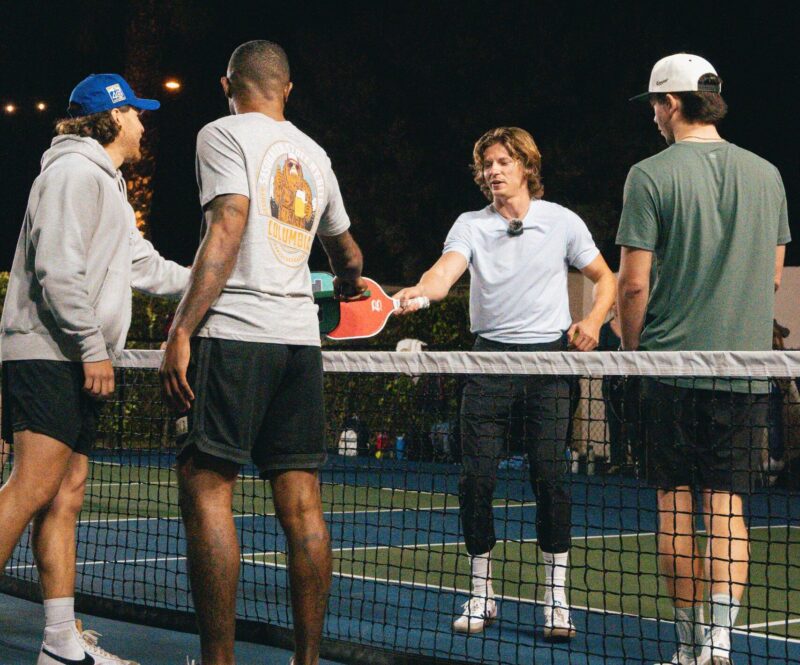
A few things help here. Frequent tactile contact, paddle taps or a quick handshake between points, acts as a shared calming signal for both of your nervous systems. Deliberately slowing your speech and lowering your vocal tone between points communicates safety, which helps prevent a shared spike in stress for both of you. And when you talk to your partner between points, stick to task oriented language, phrases like keep them deep, rather than anything that sounds like a reproach. Criticism after a missed shot does not just hurt morale, it actively works against both players recovering their focus for the next point.
End Game Pressure: Closing It Out
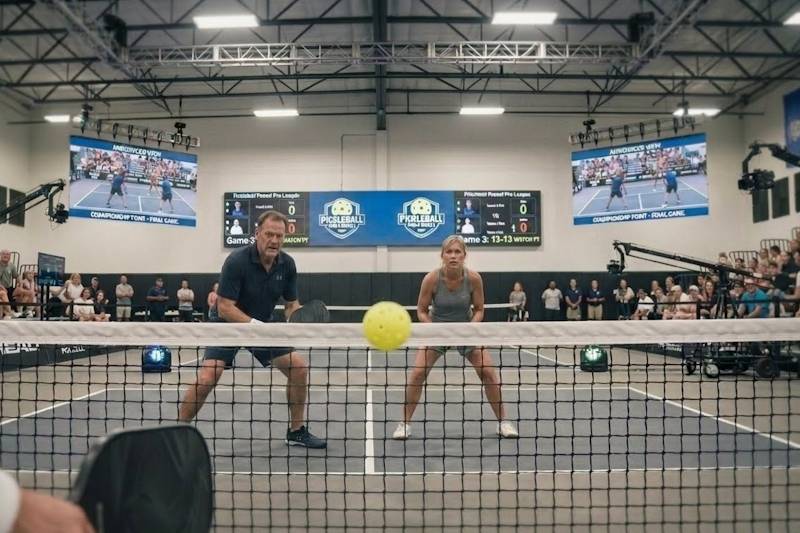
Every competitive pickleball player knows this moment. The score is tight, the games have taken their toll on your body, and every single point suddenly feels like it matters more than the ones that came before it. This is where all the work from the earlier stages of a match either holds up or falls apart.
Why the Cost of Error Feels Higher Now
Here is the piece of the puzzle that ties this whole guide together. A 20 year old who loses focus for a split second late in a close game often has enough raw reactive speed to save the point anyway. A 55 year old competitive player usually does not have that same safety net. That is not a knock on your game, it is just physiology, and it means the margin between a focused mind and a wandering one is genuinely smaller for you than it was decades ago.
This is exactly why everything covered so far in this guide, the pre-match routine, the quiet eye, the external focus cues, the 3-R reset protocol, matters more in the closing stretch of a match than at any other point. You are not trying to eliminate pressure in these final points. You are trying to keep executing while the pressure is there, because the pressure is not going anywhere.
The Mindfulness Paradox
There’s an interesting wrinkle in the research here. Mindfulness training, the practice of learning to notice and hold your attention on the present moment, has been studied in two very different groups, and the results tell two different stories.
One line of research looks at older adults in general, asking whether mindfulness training slows down cognitive aging, things like memory and focus. Mostly, it doesn’t seem to. There’s no real, measurable improvement there.
But that’s not the research that matters for you as a competitive player. A separate line of research looks at mindfulness training in athletes, and the results there are real, solid improvements in managing nerves and getting into the zone during competition. As a recreational player, you belong in this second group, not the first. You’re not just aging, you’re competing, and it’s competitive pressure, not age-related decline, that mindfulness training actually helps with.
So the takeaway isn’t “mindfulness training doesn’t work for older brains, why bother.” It’s that the research on general cognitive aging is answering a different question than the one that matters on the court. Mindfulness won’t turn back the clock on your reaction time. But it can help you manage nerves before a big point and stay locked into the present moment instead of spiraling after a mistake, the same benefits the athlete studies keep finding.
Staying Sharp When Your Legs Are Tired
By the end of a hard fought match, you are managing physical fatigue and mental fatigue at the same time, and the two feed each other. This is the moment to lean hardest on the tools that ask the least of you. A single physiological sigh between points. One deliberate quiet eye moment before you return a crucial serve. The 3-R reset after any error, no matter how minor it feels in the moment. None of these require extra energy you do not have left. That is exactly why they work when everything else about the match is asking your body for more than it wants to give.
The players who close out tight matches consistently are not always the most physically gifted ones on the court. Often, they are simply the ones whose mental tools do not require fresh legs to use.
Where the Research Still Needs to Catch Up
A quick, honest note before we wrap up. Most of what this guide draws on comes from general sport psychology research, padel studies, and a small but growing body of pickleball specific work, including a 2026 study on emotional regulation in competitive pickleball. That’s a solid foundation, but it’s not the full picture yet, especially for players over 50.
A few gaps are worth knowing about. Nobody has directly tested whether these mental skills hold up across multi-day tournaments, where fatigue builds up in a way a single match doesn’t capture. There’s no solid data yet on exactly how error spirals unfold point to point for competitive players over 50 specifically. The ideal quiet-eye fixation timing for pickleball’s ball speeds hasn’t been pinned down the way it has for padel. And no one has run direct trials comparing how choice reaction time holds up under real mental pressure in older versus younger competitive players.
None of this undermines the tools in this guide. The underlying mechanisms, anxiety’s effect on performance, error spirals, motor reinvestment, attentional control, are well established across sport psychology broadly. What’s missing is pickleball specific validation for players over 50 competing at a high level. That’s worth knowing as a player, and honestly, it’s a great opening for anyone doing research in this space.
Key Takeaways
Pickleball mental game focus is not a single skill you either have or do not have. It shifts across four distinct phases of a match, and each phase asks something different of you.
Before the game, your job is building confidence, not chasing calm. The physiological sigh and a structured warm up routine give your nervous system a deliberate runway instead of a scrambled one.
At the start of the game, your eyes do more work than your mind. Quiet eye and external focus cues keep your mechanics fluid instead of rigid.
During the mid game grind, the error spiral and motor reinvestment are the two things most likely to unravel your focus, and fatigue makes both of them worse. The 3-R reset protocol, released, regroup, refocus, is your best defense, especially once you have practiced it enough that it runs on autopilot.
In the end game, the cost of a lost focus moment is higher for you than it was decades ago, which is exactly why the tools from earlier in the match matter most when the score is close and your legs are tired.
You are not trying to eliminate anxiety, eliminate fatigue, or eliminate pressure. None of those are going anywhere. What you are training is the ability to execute anyway, in exactly the moment your body and your opponent are asking the most of you.
Conclusion
None of this happens overnight, and that is fine. The players who handle pressure well at 50, 60, and beyond are not the ones who found some trick that made the nerves disappear. They are the ones who put in the reps on their mental game the same way they put in reps on their third shot drop, deliberately, consistently, and long before it actually mattered in a match.
Pick one tool from this guide. Maybe it’s the physiological sigh before your next match, maybe it’s practicing the 3-R reset during your next drill session. Get that one thing running on autopilot before you try to stack on the next. Your mental game deserves the same patient, structured approach you already bring to the rest of your training.
If you want to go deeper on building this kind of mental toughness for competitive pickleball, that is exactly what I’m covering in my upcoming book on the mental game of pickleball, so keep an eye out for that.
Research this guide draws on:
- Marcos-Rivero, B., Becerril-Atxikallende, I., Barrenetxea-García, J., & Yanci, J. (2026). “When emotions take over, everything changes”: An exploration of emotional regulation and competitive performance in pickleball: Perspectives of players and coaches. DOI: 10.1177/17479541261444715
- Conde-Ripoll, R., Escudero-Tena, A., & Bustamante-Sánchez, Á. (2024). Pre and post-competitive anxiety and self-confidence and their relationship with technical-tactical performance in high-level men’s padel players. DOI: 10.3389/fspor.2024.1393980
- Conde-Ripoll et al. Precompetitive anxiety and self-confidence during the 2023 Finnish Padel championship in high level men’s players. Frontiers in Psychology
- Senior padel players, compared to junior padel players, show significantly higher levels of cognitive and somatic anxiety and a significantly lower level of self-confidence same Finnish padel championship research line. PMC10758230
- Padel/pickleball wellbeing systematic review: a systematic review examining associations between padel/pickleball participation and mental health, wellbeing, and mental fatigue, noting pickleball under-explores performance-related mental health across ages. PMC12341226