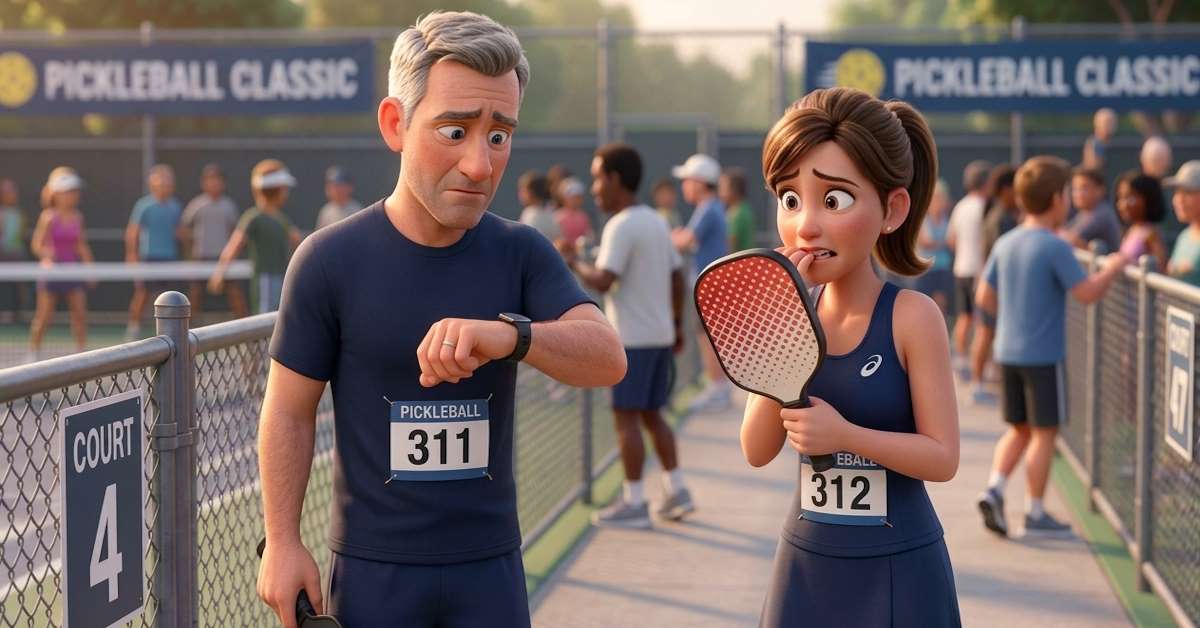
The First 3 Points: The Low-Risk Pickleball Match Strategy That Kills Early Game Anxiety
The First 3 Points: The Low-Risk Pickleball Match Strategy That Kills Early Game Anxiety
The opening exchanges of any match set a massive psychological tone for the rest of the game.
Far too many players step onto the court and rush to score immediately, attempting low percentage winners that lead to early unforced errors, which inadvertently kills their momentum and boosts their opponent’s confidence.
Understanding how to deal with pickleball anxiety during these critical initial rallies requires a shift in focus from flashy shot-making to patient, tactical stability.
By executing a low risk, highly intentional pickleball match strategy during the first three points, you give your mind and body the breathing room needed to find a natural rhythm.
Instead of starting the game on your heels in a state of panicked reaction, you build an unshakeable foundation that allows you to settle into the match smoothly and command the tempo of the entire court.
Playing with Massive Margins: Designing an Early Safety Net to Neutralize Panic
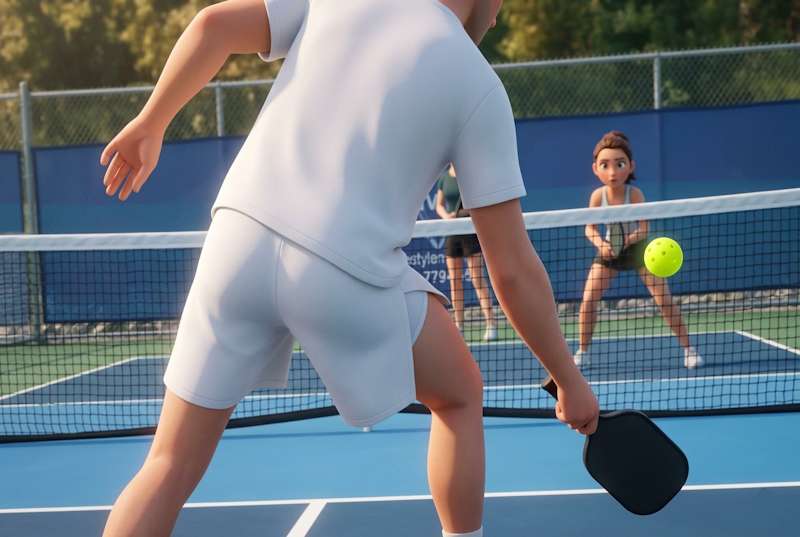
The Core Concept: The opening exchanges are not the time to challenge the white lines or paint the tape with aggressive, low percentage rollers.
By intentionally aiming for large, high safety zones on the court during the initial rallies, you create an intentional buffer system that absorbs early physical jitters and establishes a foolproof blueprint for how to beat pickleball anxiety.
- The Coach’s Perspective: I see it happen every single weekend. A player gets a little bit of early game adrenaline pumping, steps up to the kitchen line on point number one, and immediately tries to roll a sharp, cross court dink right over the lowest part of the net tape. Clank. It hits the mesh.
They just gave away a free point because they tried to play like a pro before they even found their rhythm. As your coach, I want you to banish the word “winner” from your vocabulary during the first three points of the match. Your only goal right now is to build a massive mental safety net.
Aim your dinks directly into the dead center of the kitchen. When driving or dropping from the baseline, push the ball deep into the middle of the transition zone, right between your two opponents. Give yourself two to three feet of clearing space away from every single white line and net cord.
By taking all the risk off the table early, you force your body to make clean, stress free contact, which builds immediate confidence and settles your hands down for the battles ahead.
- The Science Behind It: This conservative component of an elite pickleball match strategy relies heavily on lowering Cognitive Load and minimizing Spatial Uncertainty within the motor cortex.
In the opening minutes of a match, your brain’s Visual Spatial Processing Center is still actively calibrating to the court’s lighting, the wind patterns, and the subtle bounce discrepancies of the ball.
If you attempt an advanced, low margin stroke during this calibration phase, your brain experiences heightened neural friction, which actively exacerbates your fight or flight response.
Choosing a massive, high probability target minimizes the micro adjustments your motor cortex has to make. This down regulates cortisol production and allows your brain to conserve valuable neurotransmitters.
This offers a clear psychological pathway for managing nerves by prioritizing high percentage neural pathways over complex, high risk physical execution.
The Breakdown for the Court:
- Cognitive Load: This is the total amount of mental processing power your brain is burning through at any given second. When you first step onto the court, your brain is working overtime trying to track the wind, the sun, the crowd, and your opponents’ movements all at once. If you add a high risk shot to that list, your mental battery short circuits. Aiming for a big, safe target lowers your cognitive load, allowing your brain to calm down and find its natural groove.
- Spatial Uncertainty: This is your brain trying to figure out exactly where the boundaries are in a brand new match. Trying to hit a line on point one is like firing a weapon in the dark without adjusting your sights first. Aiming for the big, open spaces allows your eyes to accurately map the court’s dimensions without paying the price of an unforced error.
- The 3-Foot Safety Zone: Think of the kitchen line and the side bounds as high voltage electric fences during the start of the game. For the first three points, mentally shrink the court by three feet on all sides. Hitting into this “inner court” ensures that even if a nervous jitter causes you to slightly mistime your stroke, the ball still safely lands inside the lines and keeps the rally alive.
- Targeting the Dead Center: Shifting your early targets to the middle of the court doesn’t just give you physical safety it creates tactical confusion for your opponents. Forcing them to communicate over who takes the middle ball puts the psychological pressure back on their side of the net while you cruise into your comfort zone.
- Visual-Spatial Processing Center: This is your brain’s internal 3D tracking software. It is the engine that calculates exactly how fast the ball is spinning, how high it will bounce on this specific court surface, and where the lines are relative to your body. When a match first starts, this tracking software hasn’t fully booted up or calibrated to the environment yet. Giving yourself huge margins early on gives this internal software the 2 or 3 minutes it needs to fully dial in before you start aiming for the lines.
Expecting and Accepting the Rust: Breaking the Cycle of Early Judgment
The Core Concept: True psychological stability comes from anticipating early mistakes rather than being shocked by them.
By expecting early game friction, you protect your focus and establish a bulletproof routine for how to deal with pickleball anxiety.
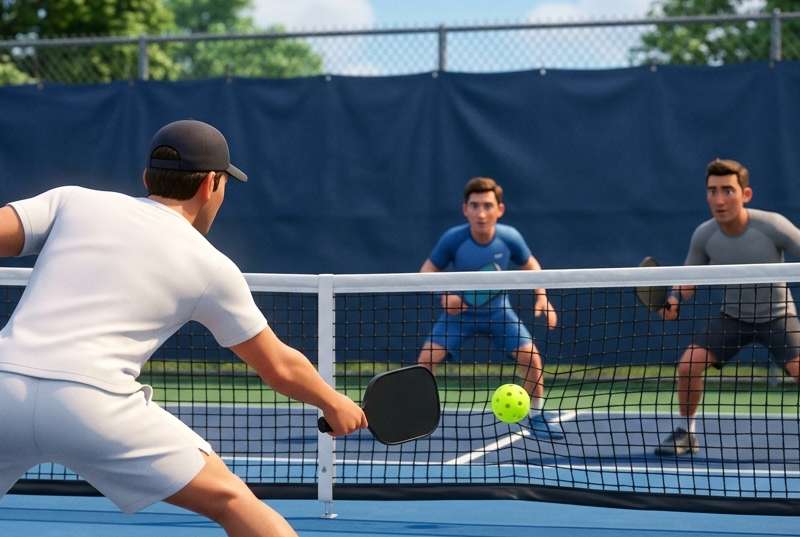
- The Coach’s Perspective: I want you to walk onto the court completely expecting to hit a bad shot or make a silly mistake during the first few rallies.
Too many players assume they should play flawlessly from the very first bounce. When they inevitably drop an early third shot into the net or misread a deep lob, they panic.
They immediately judge themselves, their grip tightens, and their internal critic starts screaming. As your coach, my rule is simple: give yourself permission to be a little rusty for the first three points.
Accepting an unforced error right away strips it of its emotional power. Giving away a single point to an early mistake is totally fine. Carrying the heavy frustration of that error into the next three points is exactly what loses games.
- The Science Behind It: This acceptance component of your pickleball match strategy relies heavily on preventing a phenomenon known as an Emotional Hijack.
When a match first starts, your brain’s Limbic System (the emotional alert center) is already highly sensitive due to natural match nerves. If you make an error and react with instant anger or self judgment, you flag that mistake as an active threat to your ego.
This causes the amygdala to trigger a sudden flood of cortisol and adrenaline. This chemical surge instantly disrupts your brain’s Motor Cortex Planning Channels, which coordinate fine motor skills.
By intentionally expecting the rust, you bypass this threat network. You categorize the error as normal data rather than a catastrophe, allowing you to stay completely calm and present.
The Breakdown for the Court:
- Emotional Hijack: This is when your frustration completely overrides your physical talent. It’s what happens when you miss a routine dink, get mad, and then immediately smash the next three balls straight into the net because you are playing out of anger rather than strategy.
- Limbic System vs. Motor Cortex: Think of your limbic system as a panicking passenger screaming in your ear, and your motor cortex as the calm driver steering your paddle face. Accepting the rust forces the panicking passenger to sit down and shut up so the driver can focus cleanly on hitting the next ball.
- The Three-Point Grace Period: Give yourself a mental pass for the first three rallies of every single match. Treat those initial points as an extension of your warmup rather than a permanent reflection of your skill level, keeping your mind loose and your confidence completely intact.
Activating Dynamic Footwork: Unfreezing Your Legs to Beat Pickleball Anxiety
The Core Concept: Match nerves always manifest physically by paralyzing your lower body.
By directing your conscious focus entirely to your movement during the opening exchanges, you override frozen legs and implement a high yield pickleball match strategy that gets your hands working automatically.
- The Coach’s Perspective: When players tell me they are struggling with how to deal with pickleball anxiety, I always tell them to stop looking at their hands and start looking at their feet.
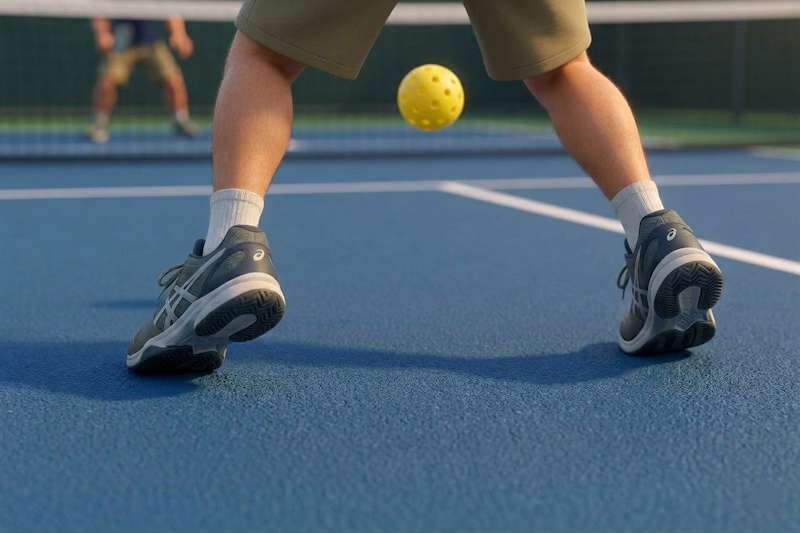
Early game jitters don’t actually ruin your stroke mechanics; they freeze your legs. You walk onto the court with heavy, cement feet, standing tall and flat footed. Because you aren’t moving, you end up reaching for the ball, hitting it out of position, and popping it up into the air.
As your coach, I want you to give your hands a break during the first three points and focus completely on your footwork. Tell your legs to click into position early, bounce on your toes, and establish your wide athletic base before your opponent strikes the ball.
If your feet are active and dancing, your hands will naturally take care of the rest on autopilot.
- The Science Behind It: This movement-heavy approach leverages a cognitive principle known as Attentional Focus Allocation to actively down regulate the nervous system.
When you panic, your brain tends to hyper-fixate on the threat the scoreboard or the fear of hitting a bad shot which activates the Sympathetic Motor Hold.
This physiological state locks up your large muscle groups, particularly in the lower extremities, to conserve energy for a primal fight-or-flight response.
By intentionally shifting your conscious attention to a mechanical, rhythmic action like foot activation, you engage your brain’s Proprioceptive Neuromuscular Pathways.
This somatic grounding trick effectively breaks the mental panic loop. It reallocates your working memory away from anxiety and signals the Basal Ganglia to unlock fluid, automated movement patterns across your entire body.
The Breakdown for the Court:
- Attentional Focus Allocation: This is your brain’s internal spotlight. If you shine that spotlight on your fear of making a mistake, your body freezes up like a deer in headlights. Shining that spotlight exclusively on bouncing your feet forces your brain to focus on movement, leaving zero room for anxious thoughts.
- Basal Ganglia: Think of this as your brain’s internal jukebox for automatic habits. It is the deep structural center responsible for storing all the skills you have practiced so many times that you don’t even have to think about them like riding a bike or hitting a routine dink. When anxiety floods your system, your conscious mind locks up and forgets what to do. By focusing your mind strictly on moving your feet, you let your legs run on autopilot, which allows the basal ganglia to quietly step in and execute your shots flawlessly from pure muscle memory.
- Proprioceptive Neuromuscular Pathways: This is your brain’s internal GPS network for your muscles and joints. It is the lightning fast mapping system that tells your body exactly where your limbs are positioned without you having to look down at your legs or paddle. When you intentionally bounce on your toes and move your feet, you instantly light up this internal GPS. This physical movement overrides match anxiety, ensuring your body knows exactly how to step into a shot smoothly without feeling uncoordinated or clumsy.
- Sympathetic Motor Hold: This is the medical term for having “cement feet.”It is your body’s primitive instinct to stay perfectly still when it feels threatened, which turns a quick split-step into a slow, flat footed lunging error.
- The Footwork Trigger: Before the first serve is struck, whisper to yourself: “Active feet, soft hands.” Make it a non negotiable rule to take at least three small adjustment steps before you touch any ball during the first three points, physically forcing your body out of panic mode.
Want to make your active feet happy feet, then look at the new Selkirk Courtstrike Pro 3.0 shoes, not only will they improve your foot performance but they may help protect you from other injuries due to poor shoe performance.
Conclusion: Surviving the Crucial Launch Window
The first three points of a game are never about demonstrating your absolute highest ceiling of athletic talent.
They are entirely about establishing your absolute baseline floor of mechanical safety and rhythm.
By actively choosing to play with massive court margins, giving your body a three point grace period to shake off the rust, and channeling your nervous energy into explosive footwork, you effortlessly bypass early game panic.
You do not need to blow your opponents off the court in the first ninety seconds to win.
Settle in, find the center of the kitchen, keep your feet dancing, and let your natural muscle memory guide you safely into the flow of the match.
Looking Ahead to Mindset #4: The Pre-Point Reset: A 5-Second In-Game Mental Strategy
You have successfully navigated the pregame anxiety, executed a deeply focused warm up routine, and settled your nerves through the opening three rallies of the match.
The score line is neck and neck, the tempo of the game is beginning to speed up, and the pressure on the court is mounting.
But as the pace accelerates, a brand new psychological trap emerges: the dangerous habit of carrying a missed shot or a frustrating mistake directly into the next serving sequence.
This mental baggage creates a rapid domino effect of bad hits that can quickly pull down your entire performance.
In our next article, we are going to dive deep into a powerful micro routine designed to completely flush away previous frustration in the quiet moments between rallies.
We will unpack the advanced sports psychology secrets behind using equipment adjustments as a physical anchor, clearing your neurochemical slate with a sharp respiratory release, and setting a single, immediate micro goal to lock in your focus before the very next ball strike.
Ready to Master Your In-Game Mental Strategy?
Don’t let a single unforced error snowball into a cascading run of lost points for your opponents.
Click the link below to discover the exact 5 second mental reset routine elite competitors use to clear their minds, protect their confidence, and stay completely locked into the present point.
Read the Next Chapter: Pickleball Mindset #4 The Pre-Point Reset: A 5-Second In-Game Mental Strategy