Why You Can’t Stop Losing Points Once You Start (The Pickleball Snowball Effect, Explained)
Mastering the Pickleball Snowball Effect: How Attentional Control Explains Your Worst Runs (and How to Stop Them)
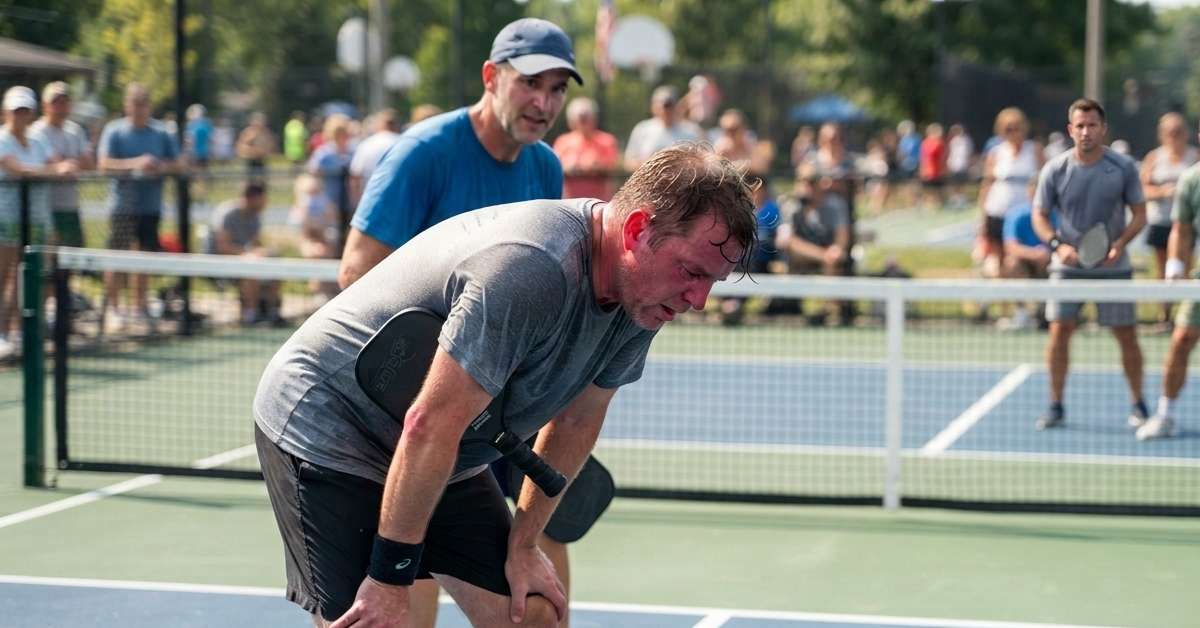
You know the run. You miss a third shot drop into the net. Next point, you rush your return and it sails long. Third point, your partner tries to bail you out and hits a ball that was clearly out. Suddenly you’re down four straight and it feels less like a scoreline and nearly like weather, something happening to you rather than something you’re doing.
I’ve watched this play out on courts for years, and I used to explain it the way most coaches do: bad luck, bad focus, “just relax.” But that explanation never held up, because the players caught in a snowball aren’t unfocused. They’re trying incredibly hard to focus. That’s actually the problem, and once you understand why, the whole thing stops feeling mysterious.
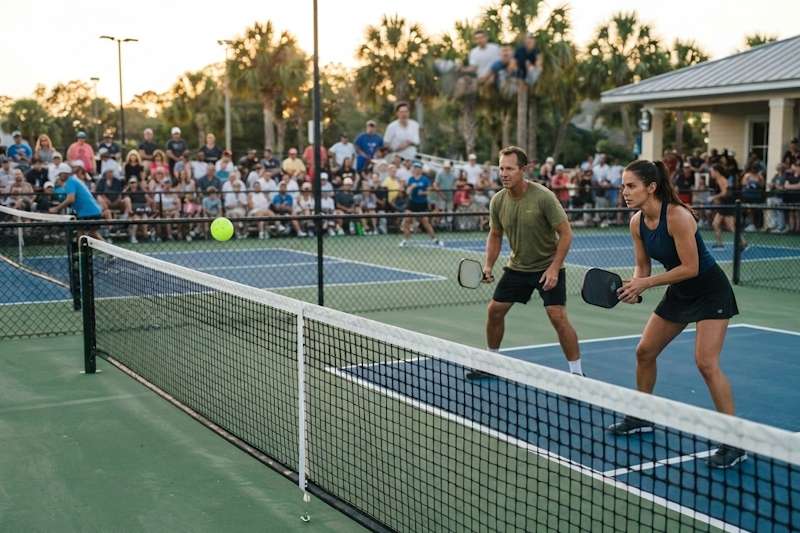
Pickleball is uniquely built for this kind of momentum swing. The court is small, the scoring is fast, and points turn over in seconds with almost no dead time to think. A tennis player who tilts has a changeover to cool off. You get about ten seconds. That compressed rhythm is exactly why the snowball effect hits pickleball players so hard, and why understanding the science behind it matters more here than in almost any other racket sport.
What Causes the Pickleball Snowball Effect: Your Brain Switching Systems Under Pressure
Here’s the concept that reframes everything: Attentional Control Theory, developed by psychologist Michael Eysenck and colleagues. It describes two different attention systems fighting for control of your brain at all times.
The first is your goal directed system, sometimes called top-down control. This is the prefrontal cortex doing its job, letting you deliberately choose what to focus on. “Watch the ball off their paddle.” “Deep middle.” That’s goal-directed attention at work, and it’s what your pre-planned focus cues depend on.
The second is your stimulus driven system, or bottom up control. This is older, faster, and more primitive. It exists to yank your attention toward anything that looks like a threat, whether or not that’s actually useful in the moment.
Under normal conditions, these two systems share the workload fine. But frustration and anxiety tilt the balance hard toward the bottom up system. Instead of the ball, your paddle angle, or the gap in the court, your attention gets hijacked by the scoreboard, the memory of your last error, or your opponent’s growing confidence. You can still say your cue word in your head. You just can’t get much processing power behind it anymore, because the system that executes it has been quietly sidelined.
This is why players in the middle of the pickleball snowball effect so often say some version of “I knew exactly what I wanted to do, I just couldn’t do it.” That’s not a lack of effort. That’s a system level mismatch, and it’s the real reason a lot of standard mental resets fail right when you need them most.
The Biological Chain Reaction Behind the Pickleball Snowball Effect
Once the goal directed system starts losing ground, a cascade kicks in that most players never see clearly because it happens in under a second.
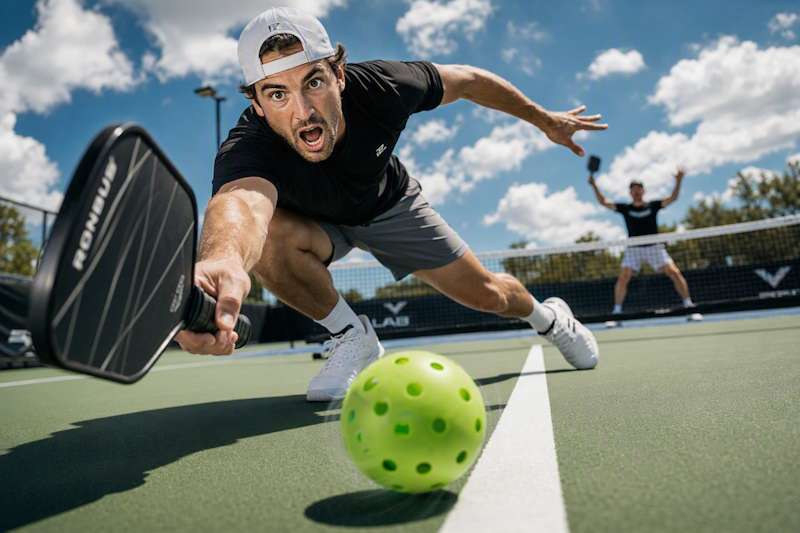
An unforced error, or a bad line call that feels unjust, gets read by your amygdala as a threat. Not a threat to your life, obviously, but a threat to your goal, and often to your ego. That triggers what sport psychologists call a threat state, marked by high anxiety and high vascular resistance, as opposed to a challenge state, which is high energy paired with low resistance. Your sympathetic nervous system floods your body with cortisol and adrenaline. Heart rate climbs. Breathing shortens. Your grip tightens. Your visual scanning narrows. Fine motor control, the exact thing you need for a soft dink or a controlled reset, gets worse in real time.
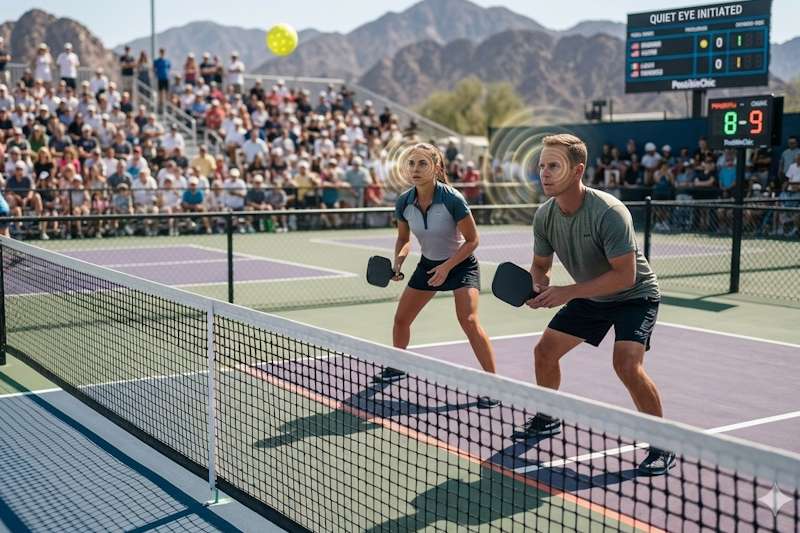
This has a direct effect on something called Quiet Eye, the stable visual fixation elite performers hold on a target just before they move. Quiet Eye research consistently shows that better players hold that fixation longer and steadier than less skilled ones. But Quiet Eye depends entirely on attentional stability, the very thing frustration destroys. When you’re emotionally flooded, your eyes start searching, checking, and rushing instead of settling. You cannot will yourself into Quiet Eye while your nervous system is still in alarm mode. The emotional piece has to be handled first.
There’s a second trap hiding inside all of this, and it’s almost cruelly ironic: trying harder often makes things worse. Sport psychologists call it reinvestment. Most of your stroke mechanics, at your skill level, are automated. They run below conscious awareness, the way you don’t think about each individual step while walking. Frustration triggers self consciousness, and self consciousness drags those automated movements back under manual, step by step control. That’s the textbook definition of paralysis by analysis, and it’s why a player who is trying their absolute hardest can suddenly look stiff, late, and mechanical on shots they normally hit without thinking.
Put the whole chain together and you get the anatomy of a snowball: error, threat biased attention, conscious over monitoring of a skill that used to be automatic, another error, a fresh sympathetic spike, repeat. It’s fast, it’s mostly automatic, and it feels less like a mental lapse and more like your own body working against you, because in a real sense it is.
Silencing the Inner Chatter That Fuels the Pickleball Snowball Effect
A big piece of what keeps this cycle spinning is internal chatter, the running commentary of “don’t miss again” or “you’re blowing this.” That self talk isn’t harmless background noise. It occupies working memory, the same limited mental workspace you need for reading the ball and executing your shot. Every ounce of processing power spent monitoring yourself is processing power not available for the point in front of you.
One of the more useful reframes here is shifting from identity to data. When a missed shot feels like proof that you’re choking, that’s an identity threat, and identity threats are what amplify emotional intensity and make a simple reset feel weak by comparison. Elite players learn to treat errors as something closer to a statistical tax, a neutral, expected cost of playing aggressive pickleball, rather than a verdict on who they are as a competitor.
And here’s the part that surprises most players: trying to erase frustration usually backfires. Suppression takes real cognitive effort, and that effort competes with the same attentional resources you need for the next point. Modern sport psychology, including approaches rooted in Acceptance and Commitment Therapy, favors acknowledging the emotion instead of fighting it. “I’m frustrated. That’s fine. Now execute.” That small shift prevents a second layer of frustration, the frustration about being frustrated, from piling onto the first.
The Upgraded Recovery Protocol to Stop the Pickleball Snowball Effect Mid-Match
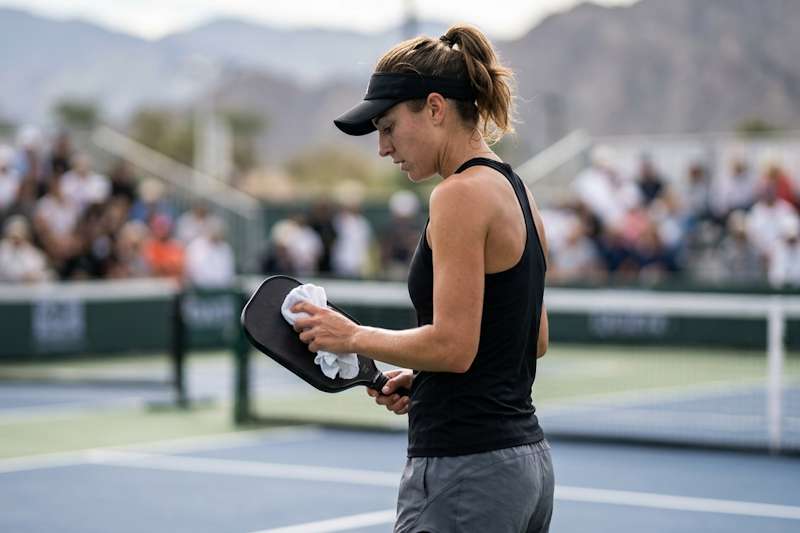
Most players already have some version of a between point reset: a breath, a paddle wipe, a focus word. The problem isn’t that these tools are wrong. It’s that they’re incomplete. They jump straight from arousal to performance without ever addressing the emotional appraisal driving the arousal in the first place. Here’s the fuller sequence, built from the research above.
Stage 1: Emotional Labeling, one to two seconds.
Immediately after the point, silently name what you’re feeling. “Frustrated.” “Tight.” “Annoyed.” This is often described as “name it to tame it,” and there’s real science behind the phrase. Briefly labeling an emotion has been shown to reduce its intensity by engaging regulatory brain networks, converting a vague, threat primed feeling into something bounded and specific. Don’t analyze it. Don’t judge it. Just name it and move on.
Stage 2: Physiological Downshift, three to five seconds.
This is where you actually change your body’s state, not just your thoughts. The physiological sigh, a double inhale through the nose followed by a long, extended exhale through the mouth, is particularly effective because the two inhales pop open collapsed alveoli in the lungs while the long exhale rapidly activates the vagus nerve, which drops heart rate faster than a single standard breath. If you have a couple more seconds, extend it further: four-count inhale, six to eight count exhale. The longer exhale is doing most of the real work here, increasing heart rate variability specifically under stressful emotional conditions. While you’re at it, relax your grip to roughly a three out of ten. Frustration causes co-contraction in the forearm, which quietly destroys touch on dinks and resets without you noticing until the ball pops up.
Stage 3: Tactical Redirection, one to two seconds.
Swap out vague commands for a controllable process cue. “Focus” and “laser focus” are empty instructions, they don’t tell your brain what to actually do. “Deep middle.” “Watch the yellow holes.” “Split early.” “High margin.” These are specific, external, and actionable, and that distinction matters more than it sounds like it should. Internal cues, things about your own body mechanics, are exactly the kind of thing that trigger the paralysis by analysis trap described above. External cues, aimed at the ball, the target, or the court, sidestep it.
Stage 4: External Commitment and Execution.
Before the serve or return, commit your gaze to one small external target: the logo on the ball, the top seam of the net. Hold it for a beat or two before you move. This is where Quiet Eye finally gets to do its job, because you’ve already done the work of calming the system that was interfering with it. One important mindset shift here: flow is not something you can force by wanting it badly enough. It’s an outcome of repeated, present focused execution, not a state you summon on command. Accept whatever happens next and let the next rep build on this one.
Preventing the Pickleball Snowball Effect: Pacing Tactics for the Whole Match
Beyond the point by point protocol, a few tactical habits separate players who stop a snowball early from players who let it run.
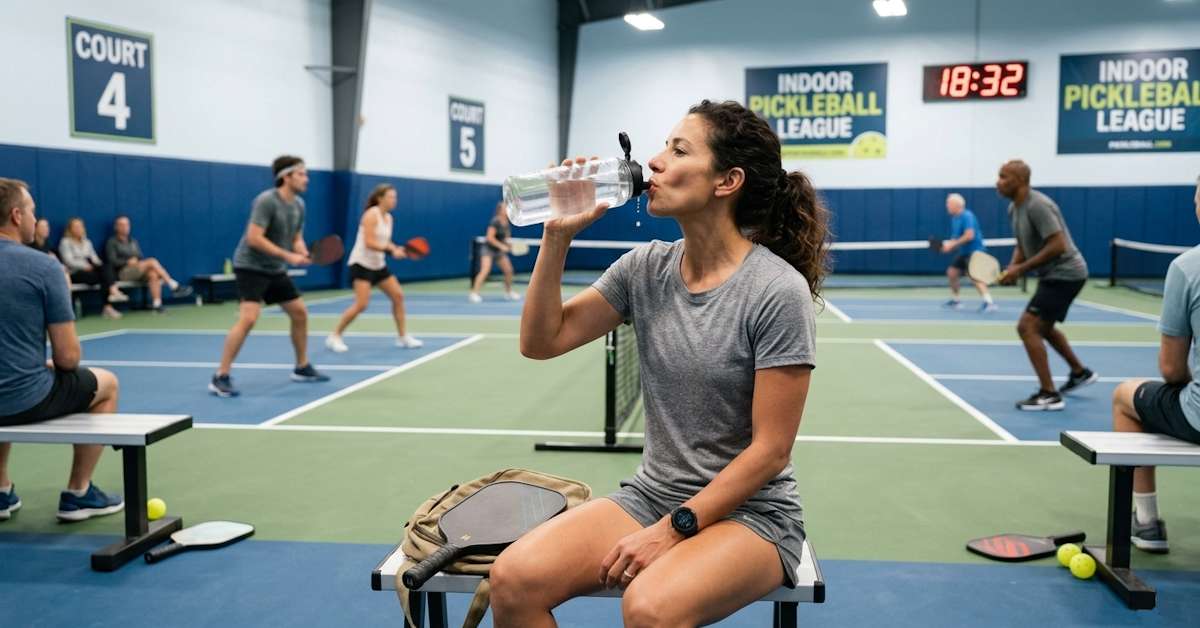
Use your full ten seconds. The rules give you a real window between points, and most club players burn through it in three. Touring pros do the opposite, deliberately stretching that interval and using something coaches often call “turning your back to the kitchen,” physically walking toward the back fence to create a real boundary between the mistake behind you and the point ahead.
Adopt a three point rule. Don’t wait until you’re down five points to intervene. The consensus among coaches is to call a timeout, real or self imposed, after three consecutive points lost. By the time you’re down four or five, your sympathetic nervous system is already maxed out, and recovery gets exponentially harder. Catching it at three is catching it while it’s still manageable.
Practice score amnesia. Deliberately treat the current point as an isolated event, disconnected from the running total. The scoreboard is one of the most reliable threat cues your brain latches onto, so removing it from your attention, even temporarily, removes a major source of the bottom up hijacking described earlier.
Watch for emotional contagion in doubles. Your frustration doesn’t stay contained to you. It reliably degrades your partner’s decision making and communication too. After an error, whether it’s yours or theirs, offer something task focused and constructive rather than evaluative. “Next ball” beats “come on, focus” every time, because the first is neutral and forward looking while the second carries judgment your partner has to process on top of everything else.
Drills That Build Resistance to the Pickleball Snowball Effect Off the Court
Like anything else in this sport, emotional regulation is trainable, not something you either have or don’t. These drills build what researchers sometimes call neural tolerance, essentially teaching your nervous system that being behind, or making a mistake, isn’t actually an emergency.
Manufactured deficit exposure. Start practice games down 0-4 or 0-5 on purpose. The goal isn’t necessarily the comeback. It’s desensitizing your brain to the feeling of being behind, so that feeling stops automatically triggering a threat response in real matches.
Mistake on purpose training. Deliberately miss a serve or dump a sitter into the net during a rec game, then immediately run your full four stage reset. This lets you practice recovering from the specific sting of an unforced error in a low stakes setting, rather than encountering that sting for the first time when a tournament match is on the line.
Score blind process games. Play a full game without tracking the score, or have your partner track it instead. Your only performance metric becomes the quality of your resets. This retrains your brain to reinforce the behavior you actually control, rather than an outcome you don’t.
The opponent winner reframe. When your opponent hits a genuinely great shot, give them a quick, neutral “good ball” within a couple of seconds. This keeps your brain from quietly filing their skill away as your personal failure, which is a surprisingly common and surprisingly sneaky source of frustration that has nothing to do with your own errors at all.
Why Elite Players Escape the Pickleball Snowball Effect Faster Than You Do
Here’s the thing that took me a long time to really internalize: the best players you’ll ever share a court with are not calmer than you. They still feel the sting of a bad call, the sick drop in your stomach after blowing an easy put away, all of it. What separates them isn’t the absence of frustration. It’s the speed of recovery, how quickly they can move from that jolt of emotional activation back to task focused engagement.
That’s not a personality trait. It’s a skill, built the same way every other skill in this game gets built, through repetition under realistic conditions. Flow isn’t a state you can force your way into while emotionally flooded. It’s what shows up naturally once you’ve done the quieter, less glamorous work of regulating first. Master that sequence, emotion, body, task, vision, and the snowball stops being something that happens to you. It becomes just one more pattern you know how to interrupt.